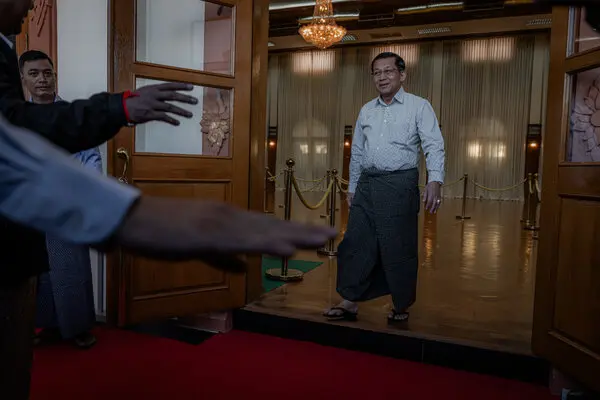
General Min Aung Hlaing, the head of the military in Myanmar, resigned on Monday from his role as Commander-in-Chief, clearing the path for him to become the next president of the conflict-ridden nation. This decision is part of a calculated plan to enhance military control over governance, with expectations that he will be installed by a parliament viewed as a facade for military authority.
These developments come five years after Hlaing led a coup against civilian leader Aung San Suu Kyi, a Nobel Peace Prize laureate who remains detained in an undisclosed location. Hlaing is seen as a controversial figure in Myanmar, regarded as a symbol of the military repression that the country has experienced.
Details of the Event
Hlaing has been nominated as one of three candidates for the vice presidency, and he is expected to be selected for the presidency in a final vote by parliament next month. Myanmar's military constitution requires that two different individuals hold the positions of president and Commander-in-Chief, prompting Hlaing to relinquish his role as military chief.
General Yewin Oo, aged 60, will replace Hlaing as Commander-in-Chief of the military. Yewin Oo is known as a reliable ally of Hlaing and has overseen interrogation centers where thousands of political prisoners have been tortured since the coup.
Background & Context
Myanmar's history is rife with political and military conflicts, having experienced several military coups since gaining independence from British colonial rule in 1948. In 2011, Myanmar began a phase of political reforms, but the military coup in February 2021 reverted the country to a state of repression and turmoil.
Aung San Suu Kyi is considered a symbol of democracy in Myanmar, and Hlaing's coup has faced widespread international condemnation, with many countries and human rights organizations denouncing the military's abuses against civilians.
Impact & Consequences
These developments raise new concerns about the future of democracy in Myanmar, as Hlaing is believed to be seeking to consolidate his power through control of the presidency. This shift illustrates how the military still retains significant influence in politics, which could exacerbate humanitarian and economic conditions in the country.
This move may also escalate tensions between the military government and the international community, which is closely monitoring the situation in Myanmar. There may be increasing pressure on the military government to make political concessions, but history shows that the military tends to ignore such pressures.
Regional Significance
The events in Myanmar highlight how military regimes can impact political and economic stability in countries. In the Arab world, we have witnessed similar experiences with military regimes governing some nations, raising questions about how to achieve democracy and human rights under such systems.
The situation in Myanmar serves as an important lesson for Arab countries striving for political stability, emphasizing the need for effective mechanisms to ensure that failed experiences are not repeated.