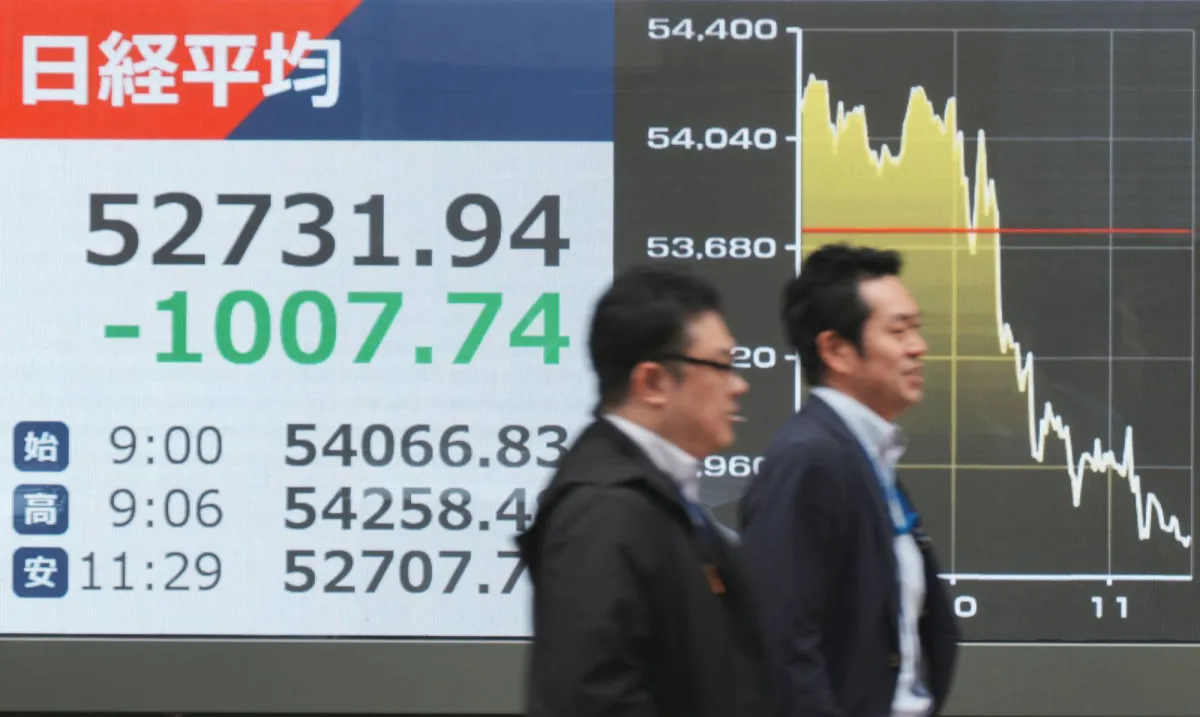
Global markets experienced notable disruptions on Thursday, with stock indices falling and oil prices rising following U.S. President Donald Trump's speech announcing continued military operations against Iran. This announcement dashed investors' hopes for a quick resolution to the conflict in the Middle East, reinstating a sense of caution and vigilance in the markets.
Trump's speech, characterized by an aggressive tone, confirmed that the United States would launch "very severe" strikes in the next two to three weeks, raising concerns about the deterioration of the situation on the ground. The lack of a clear timeline for ending the conflict and the possibility of "boots on the ground" prompted investors to adopt defensive positions, especially with a long weekend approaching.
Market Reactions
In the stock markets, U.S. futures fell by 1%, while European contracts plummeted by more than 1.5%. The Japanese Nikkei index suffered a loss of 1.8%, and South Korea's KOSPI index saw a sharp decline of 3.6%, amid widespread selling across most regional exchanges.
In the energy sector, Brent crude oil prices surged by around 5% to exceed $106 per barrel, due to the absence of any reassurances regarding the reopening of the Strait of Hormuz, a vital artery for global fuel supplies. Trump's statements that the U.S. does not need this strategic oil passage and that it would be reopened "naturally" once the conflict ends were seen as indications that supply disruptions could last longer than expected.
Background & Context
These developments come at a time when the global economy is grappling with high inflationary pressures and slowing growth, bringing the specter of "stagflation" back into focus. Amid this turmoil, the U.S. dollar strengthened its position as a safe haven, with the dollar index rising by 0.3% against a basket of major currencies.
The U.S. dollar regained upward momentum following Trump's speech, with the dollar index climbing to 99.925euro and the British pound.
Impact & Consequences
Mainland Chinese stocks and the Hong Kong stock exchange saw significant declines, with the Shanghai Composite index dropping by 0.53%, while the CSI 300 index lost 0.74% of its value. In Hong Kong, the Hang Seng index fell by 1.1%, with a sharp decline in the technology sector.
Gold prices also experienced a sharp turnaround, dropping by more than 1% following Trump's escalatory remarks. The spot gold price fell by 1.3% to $4694.48 per ounce, while U.S. gold futures dropped by 1.9% to $4723.70.
Regional Significance
These developments directly impact the Arab region, as the ongoing conflict in Iran reflects the increasing risks to the stability of financial markets in the Middle East. Additionally, rising oil prices may negatively affect the economies of oil-importing countries, increasing economic pressures.
In conclusion, investors remain on alert for what the upcoming developments will bring, especially with the non-farm payroll report in the United States approaching, which could reshape monetary policy expectations.