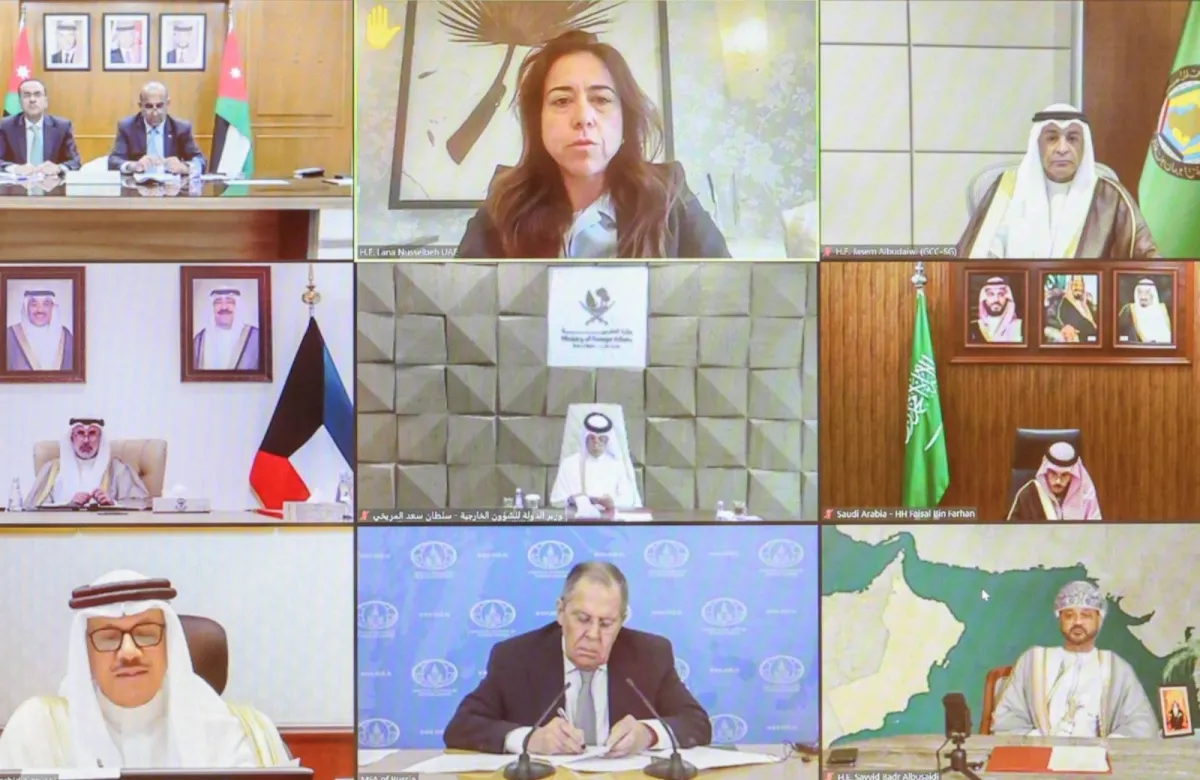
A Gulf-Jordan-Russia ministerial meeting on Monday discussed the latest developments regarding Iranian escalation and its effects on the Gulf Cooperation Council (GCC) countries and Jordan. The meeting, chaired by Dr. Abdullatif Al-Zayani, the Bahraini Foreign Minister, included participation from foreign ministers of Gulf states, along with Russian Foreign Minister Sergey Lavrov.
During the meeting, the ministers stressed the need for continued coordination and consultation to address the security challenges posed by Iranian aggressions. The Secretary-General of the GCC, Jassem Al-Budaiwi, highlighted the Iranian attacks targeting Gulf states and Jordan.
Details of the Event
In a related context, Saudi air defenses intercepted several hostile aerial targets, successfully thwarting five ballistic missiles and a cruise missile, in addition to seven drones over the past hours. Major General Turki Al-Maliki, the official spokesperson for the Ministry of Defense, confirmed the success of air defenses in dealing with these threats.
Moreover, Saudi Defense Minister Prince Khalid bin Salman reviewed the strategic defense partnership with his British counterpart John Healey, where they discussed regional developments and their implications for security and stability.
Background & Context
These meetings come at a sensitive time as the region witnesses an escalation in Iranian aggressions. Saudi Arabia and other Arab nations condemned the attacks targeting a camp belonging to the Kuwaiti armed forces and a power station in Kuwait, resulting in injuries among Kuwaiti forces.
In Kuwait, the Ministry of Electricity announced that a power generation station was subjected to an Iranian attack, leading to the death of an Indian worker and causing material damage to the building. Additionally, Kuwait decided to establish a specialized prosecution to combat security threats.
Impact & Consequences
Concerns are rising that these aggressions may lead to greater escalation in the region, as Saudi Arabia, Jordan, and Qatar affirmed that the recurrence of Iranian attacks represents a threat to regional security. During a trilateral meeting in Jeddah, Prince Mohammed bin Salman discussed with King Abdullah II and Sheikh Tamim bin Hamad the implications of military escalation on international navigation freedom and energy supply security.
This escalation reflects rising tensions in the region and negatively impacts economic and social stability, raising concerns within the international community.
Regional Significance
These events underscore the importance of Arab coordination to address security challenges, as countries like Qatar, Egypt, and Jordan condemned the Iranian aggressions, emphasizing the need for Arab solidarity in confronting these threats. The continuation of these aggressions could lead to greater military escalation, affecting both regional and global security.
In conclusion, the situation in the region remains tense, necessitating joint efforts from Arab countries to tackle security challenges and maintain stability.