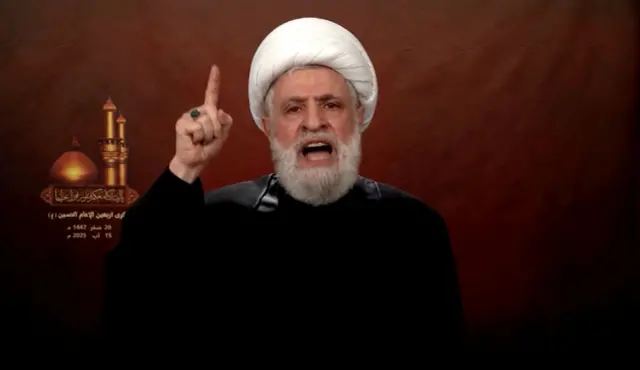
In a strong statement, Hezbollah's Secretary-General, Naeem Qassem, announced the party's rejection of the ceasefire agreement reached between Israel and Lebanon, considering it a surrender and a defeat for the Lebanese people. Qassem affirmed that this agreement is categorically rejected by many Lebanese, pointing out that the negotiations leading to it were "absurd, humiliating, and disgraceful for Lebanon."
Qassem added that peace cannot be achieved while Israeli attacks on Lebanese villages continue, warning that these aggressions will exacerbate the situation in the region. He confirmed that Hezbollah remains committed to resisting the Israeli occupation and will not back down from its stance in defending Lebanon and its people.
Details of the Event
Qassem's statements come at a sensitive time, as the Lebanese-Israeli border has witnessed an escalation in hostilities, prompting the international community to call for a ceasefire. Despite international pressures, Hezbollah insists on its position rejecting any agreement it deems unjust or harmful to Lebanon's interests.
Reports indicate that the negotiations leading to this agreement began some time ago but faced numerous obstacles, including disagreements over specific terms. Some political circles have deemed these negotiations merely an attempt to ease tensions without achieving any tangible results.
Background & Context
Historically, the relationship between Lebanon and Israel has been tense, with the region experiencing numerous armed conflicts. Since 2006, when the Second Lebanon War broke out, intermittent clashes between the two sides have continued, complicating the situation in the region.
The issue of maritime borders and disputes over natural resources are among the main causes of tension between Lebanon and Israel. These issues have heightened tensions, especially with the discovery of gas fields in the Mediterranean Sea.
Impact & Consequences
Hezbollah's rejection of this agreement could lead to a new escalation in hostilities, threatening the stability of Lebanon and the entire region. This escalation may have negative repercussions on the Lebanese economy, which is already suffering from multiple crises.
Furthermore, the continuation of the conflict could affect Lebanon's relations with the international community, as the Lebanese government may be viewed as incapable of managing the security and political situations in the country. This could lead to a reduction in international support for Lebanon amid the economic and social crises it faces.
Regional Significance
Hezbollah's stance against the agreement serves as a message to regional and international powers that Lebanon will not abandon its rights. This position may influence Lebanon's relations with other Arab countries, where opinions may vary on how to deal with Israel.
At the same time, some regional parties may exploit this escalation to enhance their influence in the area, further complicating the situation. Therefore, the situation in Lebanon remains under close observation, as any new developments could lead to radical changes in the regional landscape.