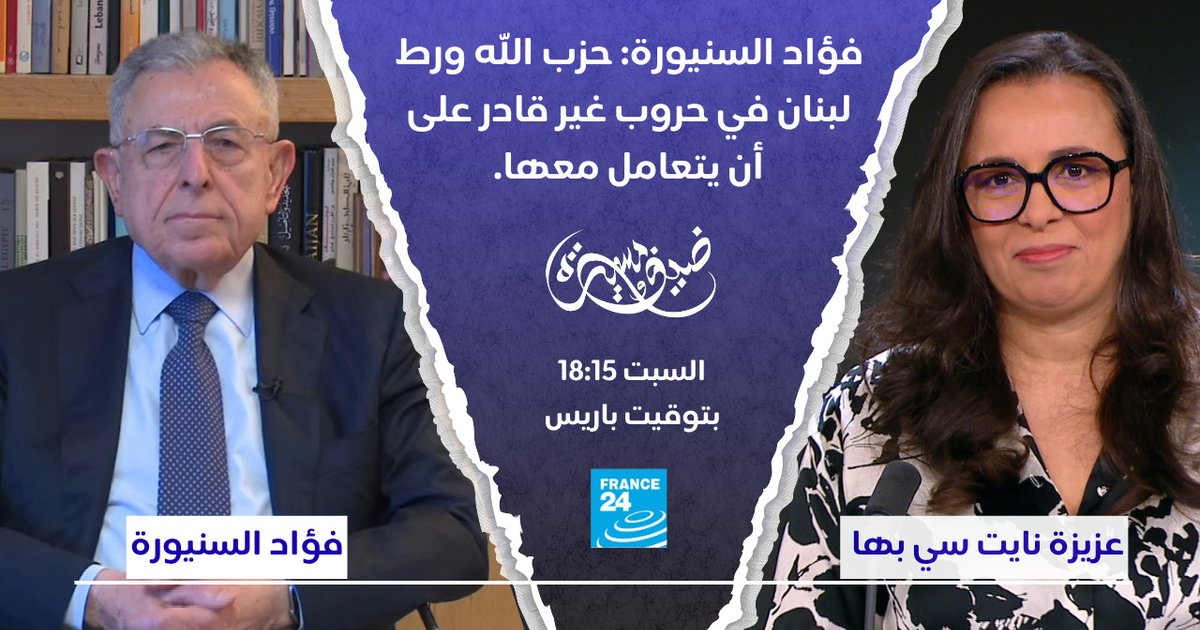
In a new episode of the program 'Guest and Journey', former Lebanese Prime Minister Fouad Siniora discussed the modern history of Lebanon, noting that the country has suffered from consecutive crises since its independence in 1943. Siniora stated that these crises, starting from the Palestinian Nakba to regional wars, have hindered the development of the Lebanese political system and the proper implementation of the Taif Agreement.
He explained that the core of the Lebanese crisis lies in the state's inability to adapt to crises, which has left it in a state of ongoing fragility. Siniora stressed that Lebanon needs to rebuild its institutions and reinforce its sovereignty, which requires a clear strategic vision.
Event Details
Siniora reviewed his professional journey, mentioning that he spent over a quarter of a century in the banking sector, which shaped his vision for the Lebanese economy. He affirmed that Lebanon's historical success was linked to an economic model based on education and services, where it managed to provide distinguished services to the Arab region.
Siniora transitioned to a pivotal phase in his career, where he worked alongside Rafik Hariri in the reconstruction of Lebanon after the civil war. He considered that the biggest challenge was to restart the economy under exceptional conditions, noting that the vision relied on stimulating investment and restoring confidence.
Context and Background
He spoke about the period following the assassination of Rafik Hariri and the withdrawal of Syrian forces from Lebanon, considering that this moment marked a turning point in the internal balance of power. He explained that Hezbollah emerged in a stronger position after Syria's withdrawal, which reshaped the political and security landscape in the country.
Siniora also pointed out that the continued presence of Hezbollah's weapons represents a central issue, as the party was supposed to hand over its arms to the state after Israel's withdrawal in 2000, but it did not. This reality led to a duality in power, where the state became incapable of monopolizing sovereign decision-making.
Consequences and Impact
In his analysis of the regional environment, Siniora considered that Lebanon has not been treated as a sovereign state, but rather as a battleground for settling scores. He confirmed that regional regimes have used Lebanon as a sphere of influence, contributing to the state's failure to assert its sovereignty.
He also noted that internal factors played a role in obstructing solutions, as there were always local tools used to hinder reforms. Siniora emphasized that the solution cannot be partial; it must start from rebuilding the state.
Impact on the Arab Region
Siniora's statements serve as a call to reconsider the internal and external policies affecting Lebanon. The absence of stability in Lebanon negatively impacts the entire region and complicates regional crises.
In closing the interview, Siniora stressed the necessity for the state to be the sole authority in peace and war, affirming that the exclusivity of arms in the hands of the state is a fundamental condition for saving Lebanon. He indicated that any future path must go through the establishment of a normal state that respects itself and its citizens.