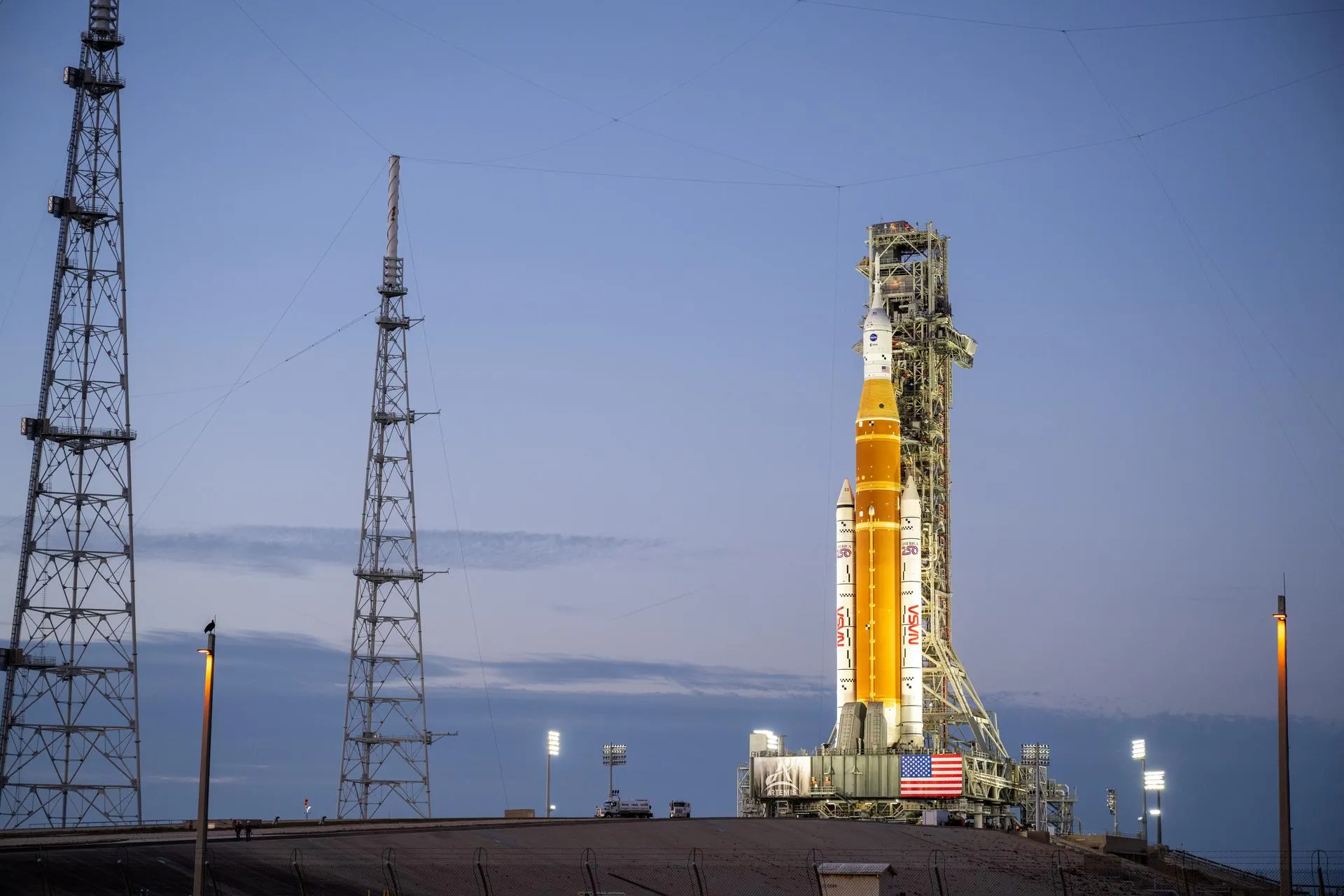
In a historic event awaited by the world, the American space agency NASA is preparing to launch its new rocket, the Space Launch System (SLS), on April 1. The mission, named Artemis II, will take four astronauts on a journey to the moon, marking the first crewed mission to the moon since Apollo 17 in December 1972.
The rocket, standing at 322 feet, will use a combination of 537,000 gallons of liquid hydrogen and 196,000 gallons of liquid oxygen to produce a thrust of up to 1.7 million pounds, in addition to a boost from solid rockets adding another 3.3 million pounds. The journey will last for ten days, during which the astronauts will conduct the first flyby around the moon.
Event Details
The crew of four includes commander Reid Wiseman, pilot Victor Glover, mission specialist Christina Koch, and specialist Jeremy Hansen, who will be the first Canadian to travel to the moon. This journey will place them among only 24 people in history who have traveled to the moon, with the expected distance being approximately 250,000 miles.
This mission will be unique as the astronauts will travel at a higher altitude than any previous mission, allowing them to see more lunar landmarks, including the far side that has only been viewed by a few humans.
Background & Context
The Artemis II mission follows more than three years after the Artemis I mission, which was the first uncrewed test flight of the SLS rocket and the Orion spacecraft. While the first flight carried mannequins to measure radiation levels, this mission will see humans return to the moon, representing a significant step towards deep space exploration.
Through the Artemis program, NASA aims to establish a crewed lunar base in preparation for future missions to Mars. Artemis II is expected to be followed by Artemis III in mid-2027, which will test a new lunar landing vehicle.
Impact & Consequences
This mission is a significant step in space exploration, as it will provide scientists and researchers the opportunity to study the far side of the moon, which contains some of the oldest and largest craters in the solar system. This information could help in understanding Earth's history and the formation of other planets.
Moreover, this mission poses a considerable challenge, as traveling to deep space carries significant risks, requiring meticulous preparation and advanced technology to ensure the astronauts' safety. Paul Anderson, deputy manager of the Orion program at Lockheed Martin, stated that deep space travel requires special preparations due to the distance involved.
Regional Significance
This mission represents an opportunity for Arab countries to enhance their investments in space and technology. With the growing interest in space in the region, this journey could inspire a new generation of Arab scientists and engineers to explore new fields in science and technology.
Additionally, international cooperation in space could open new horizons for Arab countries in scientific research and technological development, thereby enhancing their position on the global stage.