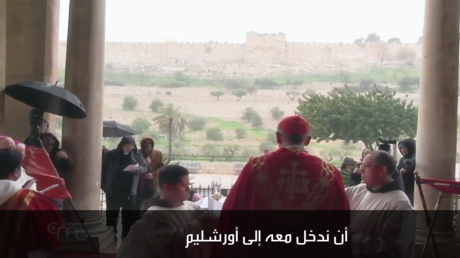
On Sunday, Cardinal Pierbattista Pizzaballa, the Latin Patriarch of Jerusalem, led a prayer for peace at the Church of All Nations in Gethsemane, marking Palm Sunday. The cardinal directed his prayers towards the city of Jerusalem, expressing hope for peace in the region.
This prayer takes place at a sensitive time, as the cardinal was prevented from entering the Church of the Holy Sepulchre, which has sparked widespread reactions from the Christian community in Palestine and around the world. This ban reflects the ongoing tensions in the Holy City and highlights the challenges faced by Christians under the current circumstances.
Details of the Event
The prayer for peace was held at the Church of All Nations, one of the prominent religious landmarks in Jerusalem, where worshippers from various Christian denominations gathered. During the prayer, Cardinal Pizzaballa called for unity and peace, emphasizing the importance of dialogue and understanding among religions.
The Church of the Holy Sepulchre is considered one of the holiest sites visited by Christians from all over the world, and the barring of the cardinal from entering it sets a precedent that could affect future religious celebrations. The cardinal noted that this ban is not merely an administrative measure, but a message reflecting the political and religious tensions in the region.
Background & Context
Historically, Jerusalem has witnessed numerous conflicts among different religions, as the city is sacred to Muslims, Christians, and Jews. With the escalation of political tensions in recent years, the situation has become more complex, adversely affecting freedom of worship.
In recent years, churches and religious sites have faced numerous challenges, including restrictions on access. These conditions have led to a decline in the number of Christian visitors to the city, threatening its cultural and religious heritage.
Impact & Consequences
The barring of the cardinal from entering the Church of the Holy Sepulchre may raise greater concerns among Christian communities and could lead to international calls for intervention to protect the rights of Christians in Jerusalem. Additionally, this incident may contribute to increased tensions between Palestinians and Israelis, negatively impacting peace efforts in the region.
Moreover, these events could affect religious tourism in Jerusalem, as the local economy heavily relies on Christian visitors. Therefore, the continuation of these tensions could lead to significant economic and social repercussions.
Regional Significance
This event represents a part of the larger picture of the Israeli-Palestinian conflict, where religion and politics intertwine in a complex manner. The barring of the cardinal from entering the Church of the Holy Sepulchre highlights the challenges faced by religious minorities in the region and reflects the urgent need for dialogue and understanding among religions.
Furthermore, these events may affect relations between Arab countries and Israel, as some nations may call for a firmer stance against Israeli policies in Jerusalem. Promoting the rights of religious minorities in the Holy City is essential for achieving peace and stability in the region.
In conclusion, Jerusalem remains a symbol of religious and cultural diversity, and it must remain open to all faiths. The prayer for peace led by Cardinal Pizzaballa reflects hope for achieving understanding and unity among all religions in this sacred city.