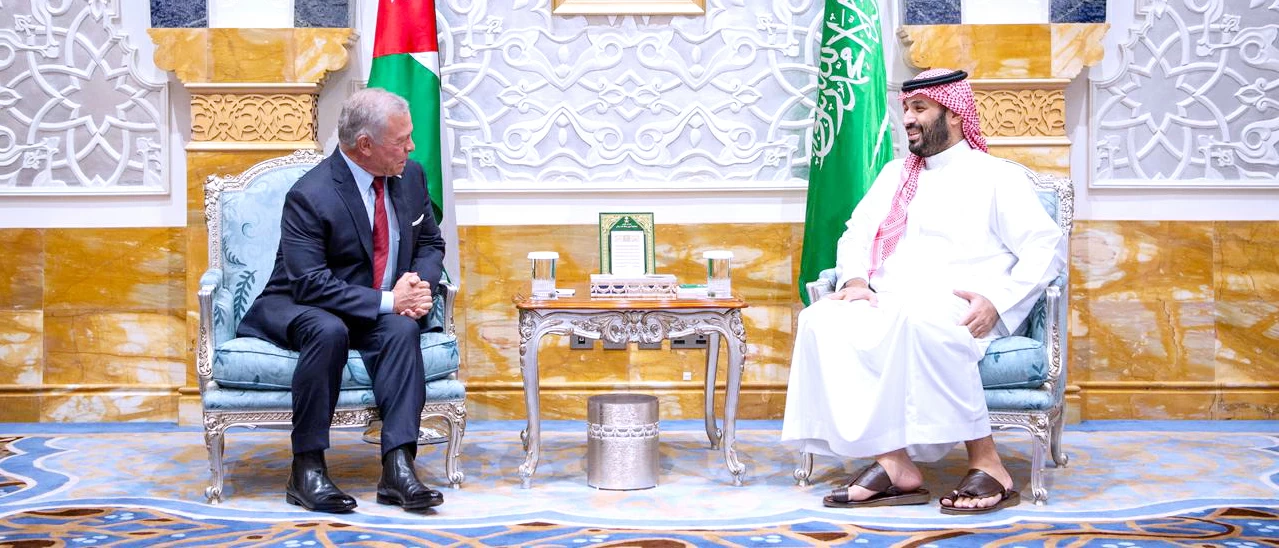
A tri-nation meeting took place in Jeddah yesterday, bringing together Saudi Crown Prince and Prime Minister Mohammed bin Salman, King of the Hashemite Kingdom of Jordan Abdullah II, and Emir of the State of Qatar Sheikh Tamim bin Hamad Al Thani. During this meeting, the recent developments in the regional situation were discussed, particularly the implications of the military escalation occurring in the area, as well as the risks posed by this escalation to international navigation and energy supply security.
It was emphasized that the ongoing Iranian attacks on the Gulf Cooperation Council countries and Jordan, targeting vital and civilian facilities, represent a serious escalation that threatens the security and stability of the region. Several officials from the three countries attended the meeting, reflecting the importance of joint coordination in addressing regional challenges.
Details of the Meeting
From the Saudi side, the meeting was attended by the Deputy Emir of the Makkah Region Prince Saud bin Mishal bin Abdulaziz, Minister of State and Member of the Council of Ministers and National Security Advisor Dr. Musaed Mohammed Al-Aiban, Director of General Intelligence Khalid Ali Al-Humaidan, and Secretary of the Crown Prince Dr. Bandar Obaid Al-Rasheed. From the Jordanian side, the attendees included Deputy Prime Minister and Minister of Foreign Affairs and Expatriates Ayman Safadi, Chairman of the Joint Chiefs of Staff Major General Youssef Al-Hunaiti, and Director of the King's Office Alaa Al-Batayneh.
On the Qatari side, the meeting was attended by Prime Minister and Minister of Foreign Affairs Sheikh Mohammed bin Abdulrahman Al Thani, Minister of Interior Sheikh Khalifa bin Hamad Al Thani, and Chief of the Amiri Diwan Abdullah bin Mohammed Al-Khalifi, along with several other officials. This meeting comes at a sensitive time when the region is experiencing heightened military tensions, necessitating intensified diplomatic efforts.
Background & Context
These meetings coincide with rising tensions in the region, where Iranian attacks on vital facilities in Gulf countries have increased, raising international concerns about energy security and navigation. The Gulf Cooperation Council countries are among the most critical regions in the world regarding energy supplies, and any threat to these supplies could significantly impact the global economy.
Furthermore, the relationships between the three countries, Saudi Arabia, Jordan, and Qatar, play a crucial role in enhancing regional stability. In recent years, there have been repeated attempts to coordinate efforts to address common challenges, especially in light of the political and economic crises faced by some countries in the region.
Impact & Consequences
The continuation of military escalation in the region could lead to serious repercussions for regional and international security. Attacks on vital facilities could result in rising oil prices, impacting the global economy and increasing instability. Additionally, threats to international navigation could affect global trade, negatively impacting local economies.
Coordination among the three countries may contribute to enhancing regional security and could have a positive impact on peace and stability efforts in the region. It is essential that these meetings continue to strengthen cooperation and information exchange to address common challenges.
Regional Significance
These meetings represent an important step towards strengthening Arab cooperation in addressing security challenges. The stability of the region heavily relies on the ability of Arab countries to coordinate with one another to confront shared threats. Furthermore, enhancing relations among these countries could contribute to improving the economic and security situation in the region.
In conclusion, hope remains pinned on these meetings to achieve stability in the region and to avoid escalation that could lead to dire consequences for all concerned countries.