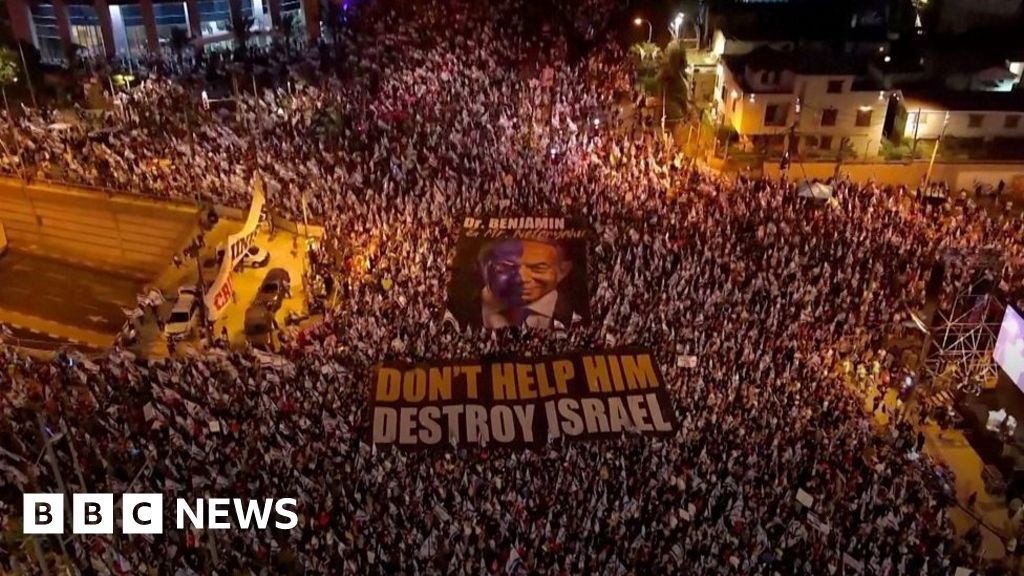
Hundreds of Israelis demonstrated on Saturday in a central square in Tel Aviv, demanding an end to the war being waged by Israel and the United States against Iran. Despite the security restrictions imposed on gatherings, protesters gathered holding signs calling for a cessation of the bombings and chanted against the policies of Prime Minister Benjamin Netanyahu.
A reporter from France Press stated that the Israeli police dispersed the demonstration and arrested several participants, a move some viewed as an attempt to silence dissent. Alon Lee Green, a spokesperson for the group Standing Together, confirmed that the protesters' demands included ending the wars in Iran, Lebanon, and Gaza, indicating that the government is trying to ignore the voices of the people.
Details of the Event
The demonstrators expressed their skepticism regarding the motives of the Israeli government, with some believing that the continuation of the war is an attempt by Netanyahu to halt his trial on corruption charges. They pointed out that the justifications for the war are constantly changing, without clear criteria for success or failure. Meanwhile, Netanyahu pledged in a video statement to continue the military campaign, indicating that targets included petrochemical factories and steel production facilities in Iran, which he described as the "money machine" funding what he termed terrorism.
In a related context, the Israeli army announced that it had detected eight rocket barrages launched from Iran since midnight, in addition to a rocket fired from Yemen on Saturday evening, resulting in at least five injuries, according to paramedics. The protesters received a warning about the Yemeni rocket, prompting them to leave the square.
Background & Context
These developments occur within the framework of the joint American-Israeli war on Iran, which began on February 28. Recently, relations between Israel and Iran have escalated significantly, with both sides exchanging attacks, heightening tensions in the region. This conflict is part of a broader struggle between regional and international powers, as both Israel and Iran seek to enhance their influence in the Middle East.
Moreover, the pressures exerted by U.S. President Donald Trump on Netanyahu to grant clemency in the corruption cases he faces may play a role in escalating the situation. This scenario reflects a state of political instability in Israel, where Netanyahu faces both internal and external challenges simultaneously.
Impact & Consequences
The recent protests reflect a growing discontent among Israelis regarding government policies, particularly concerning the war on Iran. This discontent may lead to increased pressure on the Israeli government and could contribute to changing the political landscape in the country. Additionally, the continuation of the war may negatively impact the economic and social situation in Israel, increasing anxiety among citizens.
Regionally, these developments could escalate tensions between Israel and Iran, potentially affecting security and stability in neighboring countries. The ongoing exchange of attacks might open the door for further external interventions, complicating the situation in the region.
Regional Significance
These events are significant for the Arab region, as they reflect the ongoing conflicts between regional powers. The continuation of the war on Iran may affect neighboring Arab countries, especially those suffering from internal conflicts or tensions with Iran. Furthermore, the escalation of tensions may lead to increased divisions among Arab states, complicating efforts for peace and stability in the region.
In conclusion, the events in Tel Aviv highlight the challenges facing the Israeli government and shed light on the state of political and social polarization in the country. The situations in Iran and Israel could significantly impact the future of the entire region.