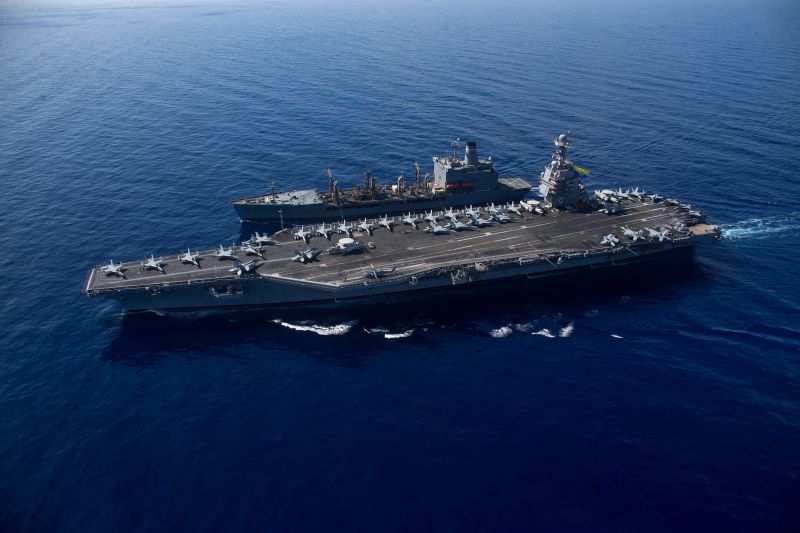
The United States is enhancing its military presence in the Middle East, having begun the deployment of thousands of troops and the aircraft carrier USS George H.W. Bush. This move raises questions about the contradiction between official statements and military actions.
According to reports from American officials, the aircraft carrier departed its port on Tuesday, heading to the region accompanied by three destroyers, in a mission that includes a comprehensive strike group of over 6,000 sailors. This maneuver comes amidst assurances from President Donald Trump's administration about progress in negotiations with Tehran, while also hinting at the possibility of military action should an agreement fail to materialize.
Details of the Deployment
In a related context, the Associated Press reported that thousands of soldiers from the 82nd Airborne Division have already begun arriving in the Middle East. Military sources indicate that these movements include approximately 1,500 paratroopers who were urgently deployed last week, alongside other forces as part of a scheduled rotation that was planned prior to the current conflict.
Despite the unclear missions announced for these forces, the nature of the 82nd Division's training suggests readiness for airborne operations in "hostile" or contested territories, aimed at securing strategic locations and vital airports. Additionally, a U.S. Navy ship carrying around 2,500 Marines has arrived in the Middle East, while another 2,500 Marines are being deployed from California.
Background & Context
These developments occur at a time when U.S. Secretary of Defense Mark Esper and other administration officials are avoiding clear answers regarding the potential deployment of U.S. ground forces within Iranian territory. This situation raises questions about the consistency of these troop buildups with President Trump's repeated statements about ending the war in the region soon.
In this context, President Donald Trump announced on Wednesday that the end of the war with Iran is near, emphasizing that the primary goal was to prevent Tehran from acquiring nuclear weapons. He stated in press remarks that the United States would leave Iran within two to three weeks, adding, "There is no reason for us to stay."
Impact & Consequences
These U.S. military movements raise questions about Washington's true intentions in the region, especially amid escalating tensions with Iran. While the U.S. administration speaks of peace, the bolstering of military forces could be interpreted as preparation for a potential military confrontation, intensifying tensions in a region already suffering from instability.
Moreover, these developments could affect relations between the United States and regional countries, as some nations may feel concerned about the increasing U.S. military presence, potentially leading to unexpected reactions from Iran and its allies in the region.
Regional Significance
In light of these circumstances, the situation in the Arab region remains one of anticipation. The U.S. military escalation could impact security and stability in countries like Iraq and Syria, where U.S. forces are already present. Any escalation with Iran could negatively affect Gulf states that rely on regional stability.
In conclusion, the question remains about how to address these developments and whether the United States will succeed in achieving its objectives without escalating the situation into a full-scale war in the region.