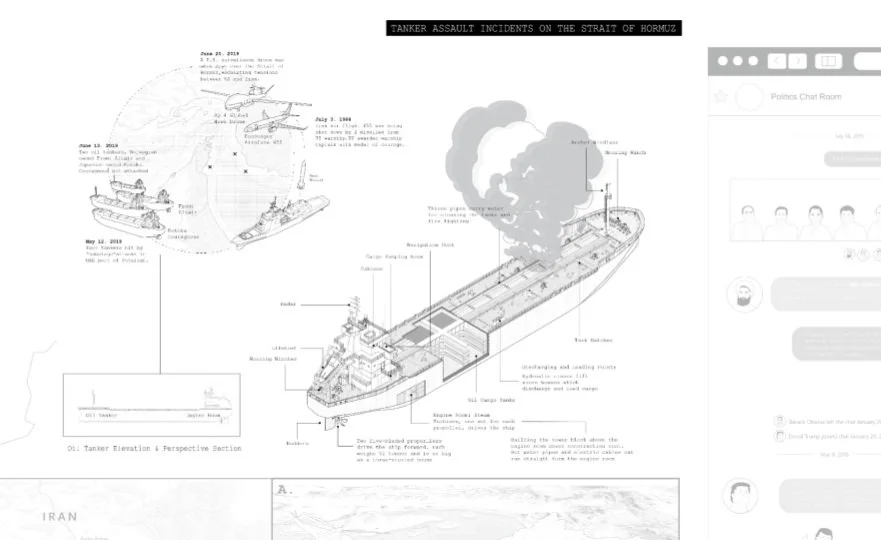
All eyes are on the Hormuz Strait as units from the U.S. Marine Corps and airborne forces arrive in the operational theater of the Middle East. This move reflects the "strategic flexibility" that Washington aims to achieve, seeking to have multiple field alternatives.
An interactive map presented by military expert Mohammad Rammal on Al Jazeera shows the positioning of the amphibious ship Tripoli, which includes an assault carrier capable of operating F-35B fighters and heavy helicopters. Additionally, the ship contains transport and landing vessels that provide integrated capabilities for transporting troops and heavy equipment and executing coastal assault operations.
Details of the Deployment
This force complements elements from the 82nd Airborne Division, known for its rapid deployment and ability to conduct airborne drops deep into enemy territory. This distribution enhances the nature of the U.S. deployment, combining amphibious operations on the coasts with aerial movements targeting vital points behind enemy lines.
In a deep analysis, Brigadier General Elias Hanna emphasizes that Marine units traditionally represent the spearhead of any U.S. intervention. These units possess integrated combat capabilities that include land, air, armored vehicles, artillery, and logistical support. However, they are not designed for prolonged wars but rather to establish a "beachhead" that paves the way for larger forces to enter and complete operations.
Background & Context
Last Sunday, the New York Times reported, citing U.S. military officials, that hundreds of U.S. special operations forces have arrived in the Middle East to join thousands of Marines and Army paratroopers. This new force adds to the 2,500 Marines and 2,500 sailors who recently reached the region, bringing the total number of U.S. forces in the Middle East to over 50,000, which is about 10,000 more than usual levels.
However, the central question, according to analyst Hanna, is not about military capability but rather about the theater of operations. Several potential scenarios emerge, the most prominent being the control of islands that dominate the Hormuz Strait, targeting Kharq Island, which represents a vital artery for Iranian oil exports, or combining both options to impose economic and operational strangulation simultaneously.
Impact & Consequences
Despite these options, the military expert stresses that the field challenges are extremely complex. The Iranian coast extends for a long distance, and the proximity of the islands to the mainland, along with the oversight of the Zagros Mountains over the area, gives Iran a firepower advantage and makes any military positioning vulnerable to targeting.
Hanna concludes that these movements do not necessarily indicate the imminent execution of a large-scale military operation but reflect Washington's efforts to build a flexible intervention capability, allowing it to act according to developments in the scene while keeping all scenarios open, despite their high costs and field complexities.
Regional Significance
These developments come at a sensitive time for the region, as tensions between the United States and Iran have escalated. President Donald Trump has intensified his threats towards Tehran, indicating military options that include controlling Iranian oil and Kharq Island, raising fears of military escalation that could affect regional stability.
In conclusion, the situation in the Hormuz Strait remains under scrutiny, with observers expecting that these U.S. military movements will have significant implications for regional security and may open the door to new scenarios in international relations in the region.