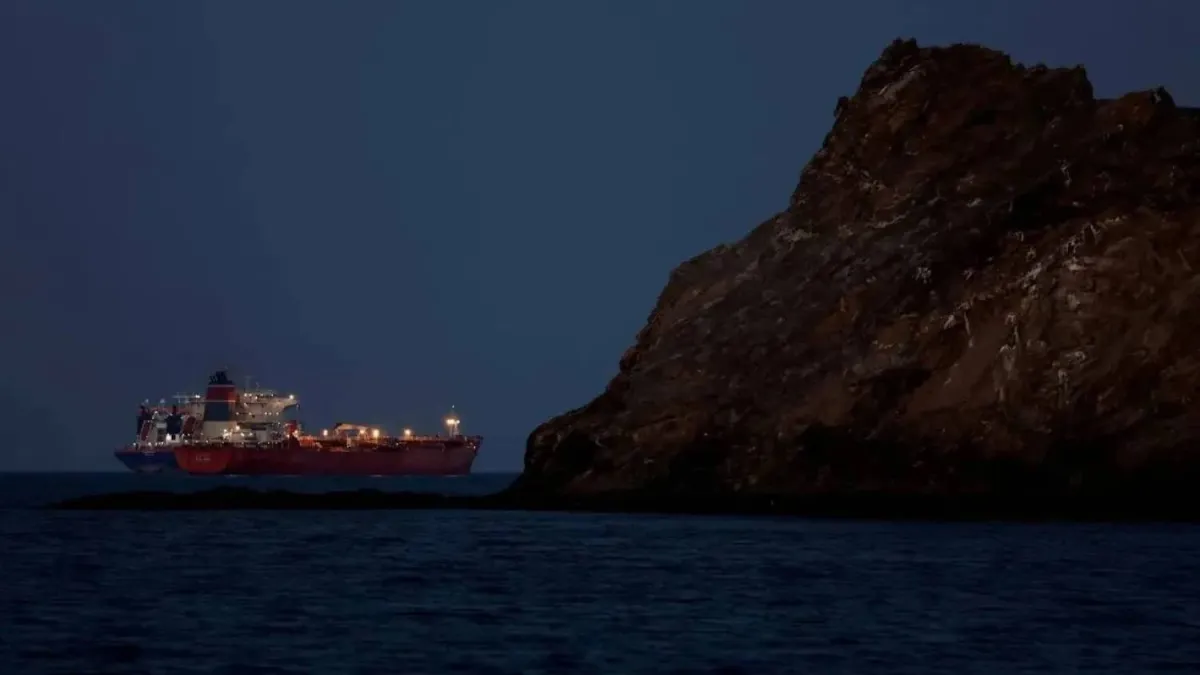
The Indian-flagged liquefied petroleum gas tanker 'Pine Gas' successfully crossed the Strait of Hormuz after a wait of nearly three weeks, amidst escalating military tensions in the region. The crew, consisting of 27 members, witnessed missiles and drones flying overhead during their wait.
One day before the attack launched by Israel and the United States on Iran on February 28, the tanker loaded a shipment at the Ruwais port in the UAE, hoping to return home within a week. However, it took nearly 21 days before the tanker could safely cross the strait, after Iran began allowing ships to pass selectively through this narrow waterway.
Details of the Event
Sohan Lal, the senior official on the tanker, reported that the crew was watching missiles and drones flying above them daily during the waiting period. In a video published by Reuters, five projectiles were seen piercing the darkness of the night above the tanker.
While Indian officials were asking the crew to prepare for sailing on March 11, it took until March 23 before the tanker was allowed to move, but not through the usual routes in Hormuz. Instead, the Iranian Revolutionary Guard issued instructions for the tanker to sail through a narrow passage north of Lark Island, near the Iranian coast.
All crew members agreed to proceed with this journey, as Indian authorities and the owning company, Seven Islands Shipping, required collective approval. Lal explained that the Revolutionary Guard suggested the Lark route, which is not typically used for shipping traffic due to mines in the usual passage through Hormuz.
Background & Context
India is considered one of the largest importers of liquefied petroleum gas in the world, with millions of Indian households relying on this substance for cooking. The tanker 'Pine Gas' was carrying 45,000 tons of gas, which was scheduled to be unloaded at Mangalore port, but it was redirected to unload equal amounts at the ports of Visakhapatnam and Haldia in the east.
Iran claims that it allows “friendly countries,” including China, Russia, India, Iraq, and Pakistan, to pass through the Strait of Hormuz. Six Indian ships have exited the strait, while there are still 18 vessels flying the Indian flag with approximately 485 Indian sailors onboard in the Gulf.
Impact & Consequences
This incident highlights the increasing tensions in the Gulf region, where concerns are rising about the impact of military conflicts on global trade. The tanker’s crossing through an unconventional route reflects the challenges faced by commercial vessels under volatile security conditions.
These events may also affect gas and oil prices in global markets, as many countries rely on these supplies. Pressure on gas-importing countries is expected to increase, potentially leading to higher prices in the near future.
Regional Significance
The Arabian Gulf region is considered one of the most important maritime corridors in the world, through which a significant percentage of oil and gas supplies pass. Any disruption in this area can have wide-ranging implications for the global economy, especially given the heavy reliance of Arab countries on oil revenues.
In conclusion, this incident reflects the ongoing challenges faced by maritime trade in the Gulf region and underscores the importance of international cooperation to ensure the safety of maritime corridors.