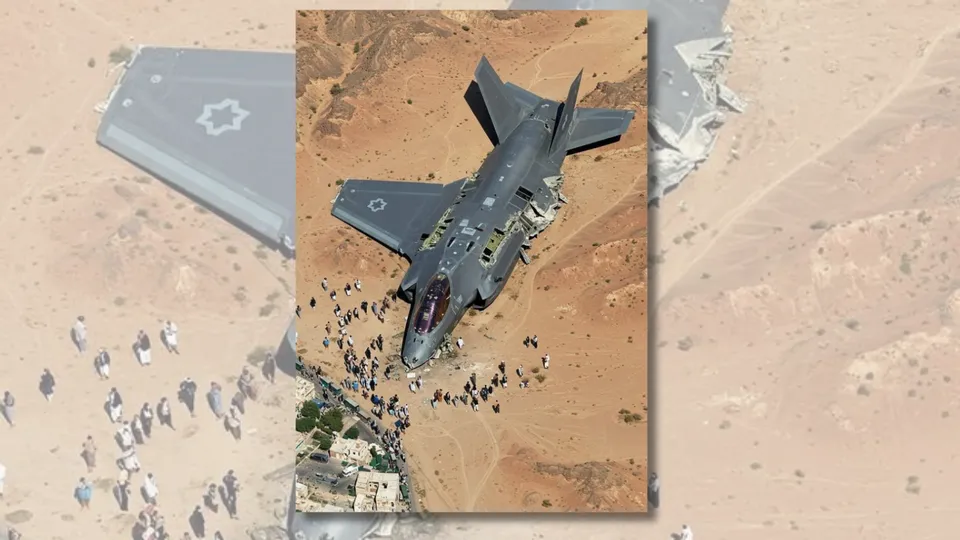
In a new development reflecting the escalating military tensions in the region, the Iranian Revolutionary Guard announced on Friday the downing of a US F-35 fighter jet, marking the second such incident during the ongoing war. The Revolutionary Guard stated in an official statement that its "advanced" air defense systems were responsible for shooting down the fighter jet, without specifying the location of the incident.
The statement added that the fate of the pilot remains unknown, indicating that the fighter jet was completely destroyed, making it difficult to determine whether the pilot survived. This announcement has elicited mixed reactions in political and military circles, as the downing of a fighter jet of this caliber is considered a significant achievement for Iran, which seeks to bolster its defensive capabilities amid rising tensions with the United States and its allies.
Details of the Incident
This incident comes at a highly sensitive time, as the region witnesses an escalation in military actions between Iran and the United States. In recent years, Iran has shown remarkable advancements in its military capabilities, including the development of advanced air defense systems. In this context, the downing of an F-35 fighter jet, regarded as one of the most advanced warplanes in the world, serves as evidence of the effectiveness of these systems.
Iran had previously announced the downing of another fighter jet of the same model earlier in the conflict, raising questions about the United States' ability to protect its aircraft in Iranian airspace. Reports have indicated that Iran has employed advanced techniques in detecting hostile aircraft, further complicating the military situation in the region.
Background & Context
Historically, relations between Iran and the United States have been marked by increasing tensions since the Islamic Revolution in 1979. Since then, the United States has imposed economic and military sanctions on Iran, leading to heightened military conflicts in the region. In recent years, the United States has increased its military presence in the Arabian Gulf, provoking strong reactions from Iran, which views these movements as a threat to its national security.
The conflict in Syria and Iraq, along with tensions in the Gulf, have contributed to the intensification of the struggle between the two sides. Iran considers the presence of US forces in the region a direct threat to its security, prompting it to enhance its military and defensive capabilities.
Impact & Consequences
The downing of a US F-35 fighter jet could have significant repercussions on the relations between Iran and the United States. This incident may lead to an escalation of military tensions, potentially dragging the region into a broader conflict. Additionally, this event could impact the United States' strategy in the region, as it may be compelled to reassess its military presence and tactics to counter Iranian threats.
Moreover, this incident could strengthen Iran's position in international negotiations, as it will showcase its ability to confront military threats. This may encourage Iran to adopt more hardline stances in negotiations related to its nuclear program and regional policies.
Regional Significance
The countries in the region are significantly affected by the tensions between Iran and the United States. The downing of the fighter jet could heighten the conflict in the Gulf, impacting security and stability in neighboring countries. Furthermore, this incident may prompt some Arab nations to reevaluate their military and political alliances in light of the escalating Iranian threats.
Ultimately, the situation in the region remains complex, with overlapping political and military interests, making it difficult to predict the developments of events. Nevertheless, the recent incident demonstrates that tensions between Iran and the United States continue to rise, necessitating close monitoring by the international community.