Iran announced on Sunday its responsibility for attacks targeting two major aluminum plants in the Gulf, which has heightened economic tensions in the region. These attacks have escalated from merely threatening shipping lanes to striking at the heart of industrial infrastructure, jeopardizing the continuity of operations in one of the most critical economic sectors.
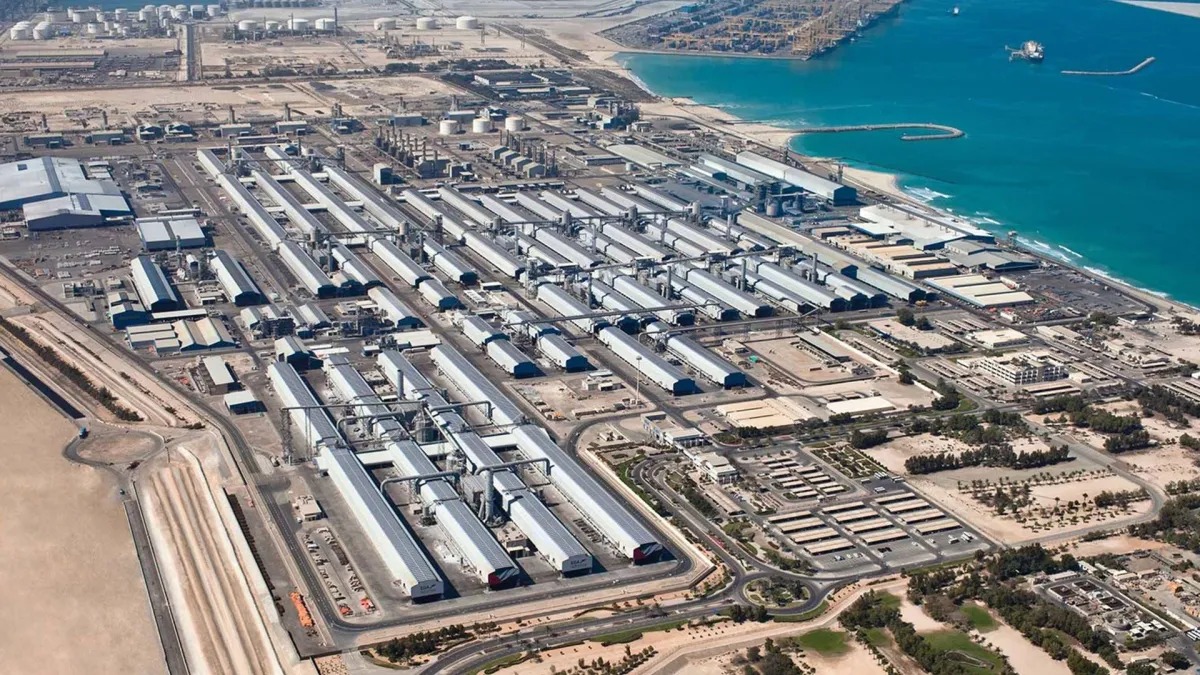
In this context, Emirates Global Aluminium—the largest non-oil industrial company in the UAE—confirmed that its vital site in Al Taweelah, Abu Dhabi, suffered significant damage due to debris from ballistic missiles. The Al Taweelah site is a global pillar that produced 1.6 million tons of aluminum in 2025 alone, while the company's second smelter is located in the Jebel Ali area of Dubai. Concurrently, Aluminium Bahrain (Alba) has begun assessing the extent of the damage to its facilities, placing major producers in the region before an existential challenge to ensure operational continuity under the weight of direct military threats.
Details of the Incident
Despite the severity of the attacks, Emirates Global Aluminium revealed a proactive move by maintaining large stocks of the metal in offshore locations and external warehouses outside the conflict zone since the war broke out last month. The company is currently utilizing this external product to meet its commitments to international customers, alleviating the impact of disruptions caused by the targeting of its local facilities.
The real danger of the recent attacks lies in the figures provided by the International Aluminium Institute; of the total global production of 29.6 million tons outside China in 2025, the Gulf region alone contributed about 23% of this amount (equivalent to 9% of the total global production of 73.8 million tons). This massive production concentration relies entirely on the Strait of Hormuz for dual import and export movements. Here, the substance alumina (aluminum oxide) emerges, which is the essential raw powder that Gulf smelters import to convert into solid metal.
Background & Context
Analysts from ING warn that smelters in the region typically hold stocks of this raw material sufficient for only 3 to 4 weeks. Since the strait is the only passage for alumina ships, continued closure will mean depletion of the raw material and a complete halt to smelting furnaces, explaining the state of "dangerous exposure" for Western markets that rely on Gulf aluminum as a vital supply that cannot be easily replaced.
According to technical analyses, the current escalation raises "material price premiums" due to insurance costs against war risks and shipping delays. The markets in Europe and the United States are the most vulnerable to this exposure, given their significant dependence on Middle Eastern metal. While the world searches for alternatives, major obstacles arise in Europe, where natural gas prices surged by 60% to reach €50.545/MWh, making it economically unfeasible for producers without independent energy sources to restart smelters in Iceland and Slovakia.
Impact & Consequences
In the United States, the intersection of regional attacks with Donald Trump's tariff policies, which raised duties to 50% in June 2025, has put the market in a state of congestion. With Canadian exports shifting towards Europe, American consumers face a terrifying scenario; estimates from Seiko Bank suggest that if aluminum prices in London reach $4,000, the final price in America—including tariffs and premiums—could approach record levels nearing $7,000 per ton, potentially leading to demand shock and threatening industries dependent on aluminum with paralysis.
Reports from Citi Bank and Standard & Poor's agree that market recovery will not be swift; shipping and insurance dynamics will take a long time to return to normal. As the opening bell approaches in global metal exchanges on Monday, anxiety prevails among traders; experts expect an immediate spike in these premiums as trading begins, driven by data on direct attacks.
Regional Significance
Yesterday, Bloomberg reported, citing an informed source, that the Saudi East-West pipeline, which provides the kingdom with an outlet amid the closure of the Strait of Hormuz, is pumping oil at its full capacity of 7 million barrels per day. Saudi Arabia has activated its emergency plan to boost exports through the East-West pipeline to the Red Sea, as the disruption of maritime navigation in the Strait of Hormuz due to the Iran war has cut off the main route for oil exports from Gulf countries.
Under these circumstances, tensions in the region are expected to persist, which could significantly impact global energy markets and exacerbate economic crises in countries reliant on aluminum and oil supplies from the Gulf. The continuation of these crises could lead to widespread economic and social repercussions, necessitating an urgent international response.