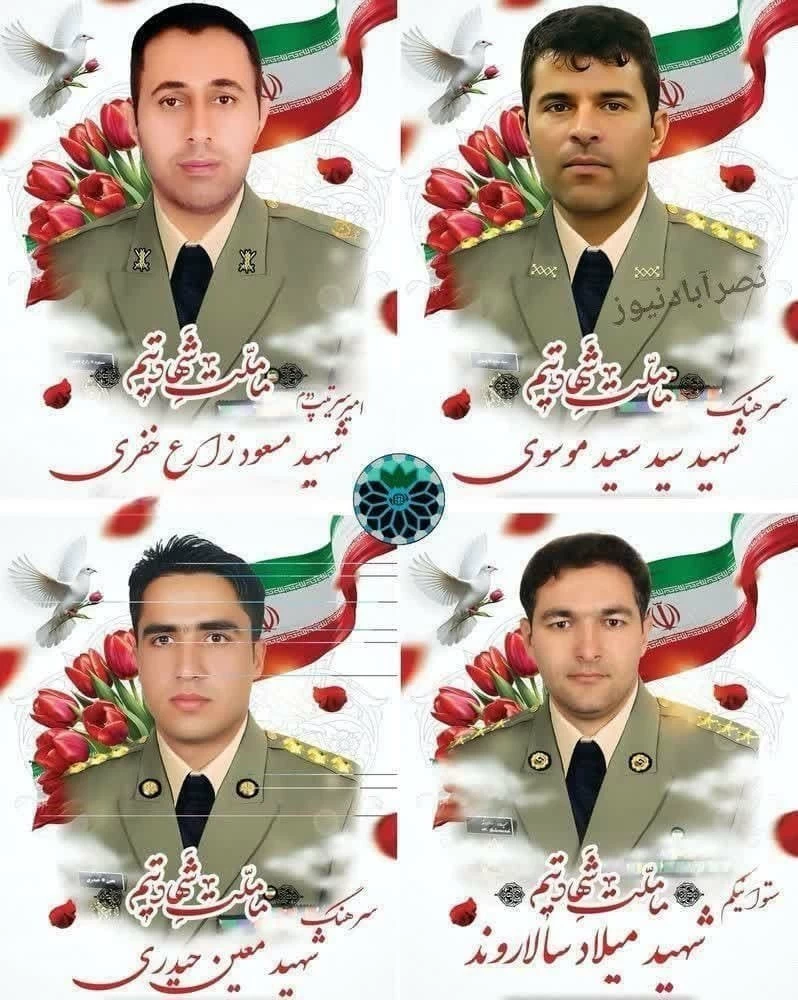
The Iranian army announced last night (Monday) the death of four of its officers during an attempt to obstruct the rescue operation for American pilots whose plane had crashed in Isfahan province. This announcement comes at a time when the region is witnessing significant military escalation.
According to the Iranian news agency 'Fars', the deceased officers were part of rapid response teams tasked with protecting Iranian airspace in the Mahyar area. One of the deceased has been identified as Brigadier General Masoud Zareh, the commander of the Defense College at the Artillery and Missile Training Center, along with three other officers of varying ranks.
Details of the Incident
The statement coincided with a press conference held by U.S. President Donald Trump and his Secretary of Defense, where they reviewed the rescue operation for the American pilots. The Iranian army confirmed that the officers were in position on Sunday morning to confront American aircraft, firing at hostile aerial targets.
The statement mentioned that after one of the American planes was hit by a shoulder-fired missile, the officers came under attack from other aircraft, leading to their deaths.
Background & Context
These events occur at a sensitive time, as Iranian-American relations are increasingly strained. Iranian forces were intensively searching for the American pilots, reflecting the level of military tension between the two sides.
Moreover, Isfahan province is experiencing heavy bombardment, with Iranian media reports indicating that the shelling targeted Kashan Airport and an ammunition depot in the area, further escalating the security situation.
Impact & Consequences
This incident is expected to lead to further escalation in tensions between Iran and the United States, with reports indicating an exchange of gunfire between the two sides. The deaths of the Iranian officers may provoke strong reactions from Iranian leadership.
This escalation could affect regional stability, as neighboring countries are closely monitoring the events, and relations between Iran and other countries in the region may be impacted.
Regional Significance
These events serve as a reminder of the fragility of security conditions in the region. They may lead to increased tensions between Arab states and Iran, especially in light of unresolved issues such as the Iranian nuclear program.
In conclusion, the situations in Isfahan and Kish Island remain under surveillance, with expectations that tensions will continue to rise in the coming days.