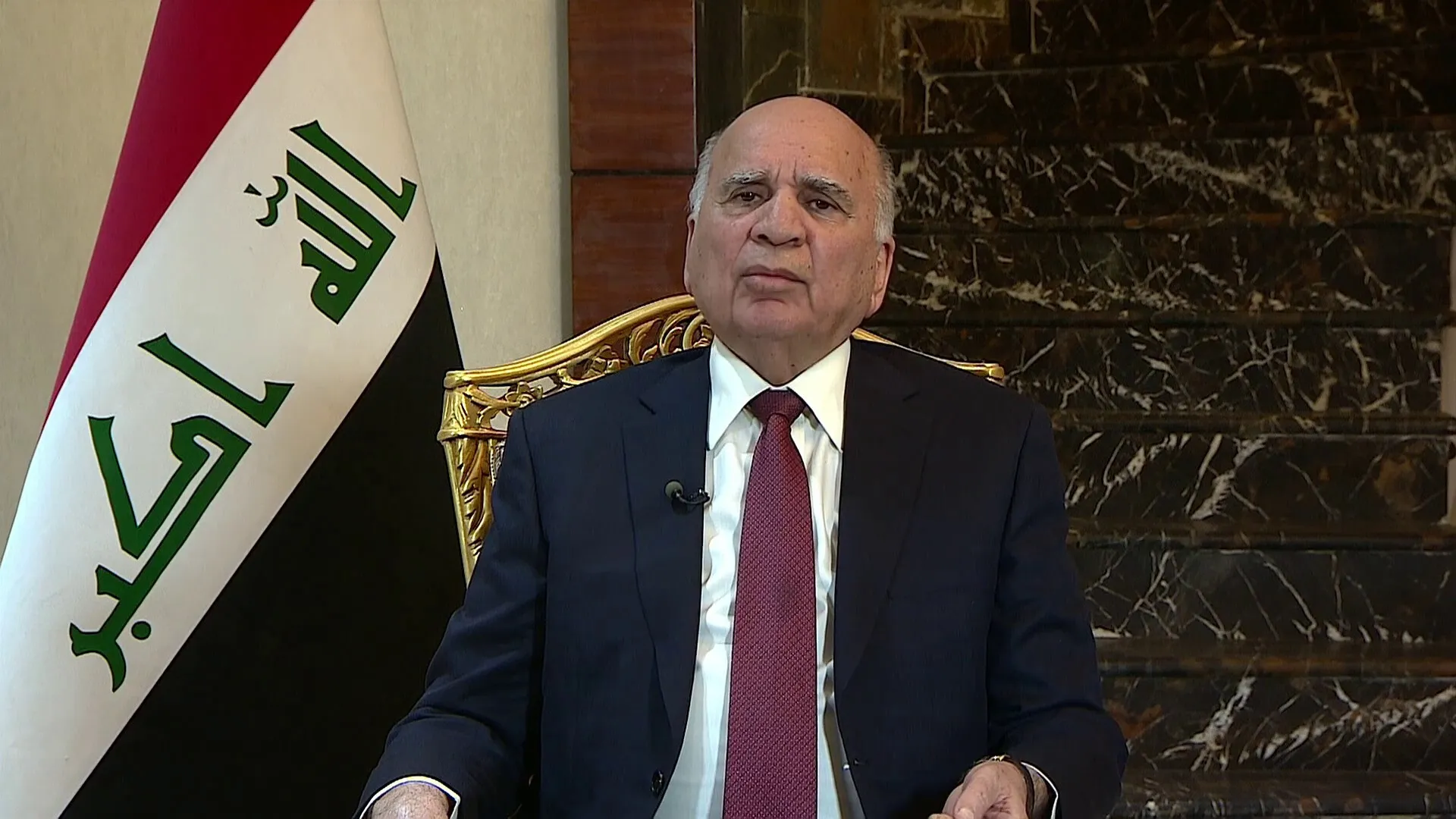
Iraqi Foreign Minister Fuad Hussein asserted that the decision of war and peace in Iraq is the prerogative of the government, not armed factions. This statement comes in light of rising tensions in the region, where Iraq's skies have become a corridor for airstrikes from multiple parties, placing the country in a difficult position.
In an interview with Al Jazeera, Hussein pointed out that Iraq is no longer merely a battleground but has become an open arena for multi-directional fire, with its territory subjected to attacks from all parties involved in the conflict. He explained that Israeli and American strikes on Iran, along with Iranian attacks on other countries, have turned Iraq into an unwanted flashpoint.
Details of the Situation
Regarding American accusations that the Iraqi government has not taken sufficient steps to protect American interests, Hussein confirmed that Baghdad condemns any attack launched from its territory against neighboring countries. However, he simultaneously urged external parties to cease targeting Iraq, emphasizing that his country has taken tangible security measures to confront these challenges, although he did not disclose details for security reasons.
Hussein also addressed the issue of armed factions and their relation to the decision of war, asserting that the Iraqi constitution assigns this decision solely to the legislative and executive branches. He clarified that no armed faction or entity within the military establishment has the right to independently decide to attack any external party.
Background & Context
Hussein's statements come at a sensitive time, as international pressures to halt the conflict, which has entered its second month, increase, complicating the security landscape in Iraq. In recent years, the country has witnessed a rise in armed activities, leading to a deterioration of the security and economic situation.
Iraq, which suffers from the effects of multiple conflicts, finds itself in a challenging position between regional and international powers. While striving to maintain its sovereignty, it faces significant challenges from armed factions operating on its territory, threatening the stability of the central government.
Impact & Consequences
The ramifications of the current situation in Iraq extend beyond national borders, as the conflict affects regional security and complicates relations between neighboring countries. The reciprocal attacks between Iran and the United States, which traverse Iraqi airspace, render Iraq an unwanted battleground, placing the Iraqi government in a precarious position.
Moreover, the continuation of the conflict could exacerbate the humanitarian situation in the country, as citizens suffer from the consequences of war, including displacement and poverty. A ceasefire and talks between the United States and Iran are considered the only viable solutions to alleviate tensions.
Regional Significance
The situation in Iraq poses a significant challenge to the Arab region, as the continuation of the conflict could destabilize neighboring countries. Iraq is a meeting point for many regional powers, and any escalation in the conflict may directly impact regional security.
In conclusion, Hussein affirmed that Iraq strongly supports any step leading to a U.S.-Iranian dialogue, indicating that peace is the only option that can ensure regional stability and restore hope for the citizens.