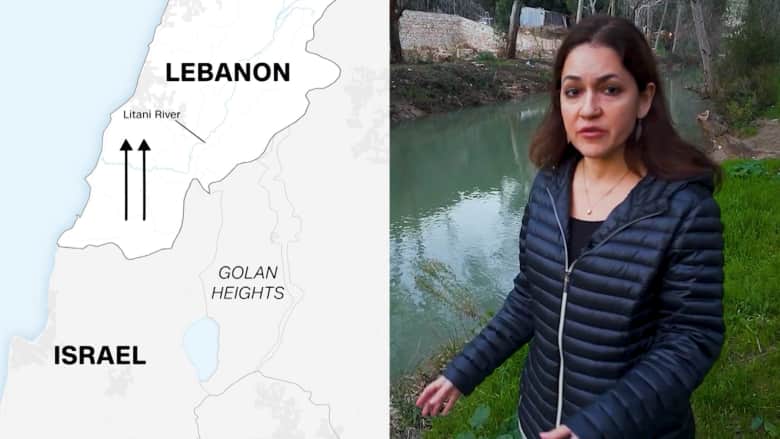
In a new escalation, Israeli Defense Minister Israel Katz announced the Israeli army's intention to impose control over extensive areas in southern Lebanon, reaching the Litani River. This move reflects a trend towards expanding Israeli aggression in the region, as Katz confirmed that military operations will continue "with full force" against Hezbollah.
Katz stated in a televised address that hundreds of thousands of Lebanese displaced from the south will not be able to return to their homes until what he described as "security guarantees" for residents of northern Israel are achieved. He also claimed that Hezbollah uses bridges over the Litani River to transport weapons and militants, asserting that the Israeli army has destroyed several of these bridges and intends to control the remaining ones.
Details of the Announcement
Katz's statements serve as the first official indication of Israel's intention to expand its ground control within southern Lebanon, as the army previously warned residents of extensive areas south of the Zahrani River to evacuate their homes. The Zahrani River is approximately 25 kilometers long, flowing through towns and villages in the nabatyeh and Sidon districts before emptying into the Mediterranean Sea at the Zahrani area south of the city of Sidon.
Since the onset of renewed attacks on Lebanon on March 2, the Israeli army has reported the destruction of five bridges on the Litani River. In this context, the UN expressed concern over Israel's intention to demolish the remaining homes in the villages and towns adjacent to the northern settlements, emphasizing the need to protect civilians and civilian structures in accordance with international humanitarian law.
Background & Context
These developments coincide with ongoing military escalation by Israel in the region, where Human Rights Watch has accused Israel of committing forced displacement and war crimes in southern Lebanon. Last Sunday, Katz stated that the army had been instructed to accelerate the demolition of the remaining homes in border villages, including the towns of Adaysseh, Kfarkela, Mais al-Jabal, and Ayta ash-Shab.
This approach, as described by Katz, resembles the model used by the occupation in the Gaza Strip, where buffer zones were created by removing and demolishing buildings near the borders. Since the beginning of the attacks, military operations have resulted in the deaths of 1,039 people and injuries to 2,876 others, in addition to over one million displaced individuals, according to Lebanese authorities.
Impact & Consequences
These statements are a serious indicator of escalating conflict in the region, as they may exacerbate the humanitarian situation in southern Lebanon. The demolition of homes constitutes a blatant violation of human rights and increases the suffering of civilians living under difficult conditions.
At the same time, these developments may affect relations between Lebanon and Israel, as tensions in the region are expected to rise, potentially leading to military responses from Hezbollah, which has declared its readiness to respond to any Israeli aggression.
Regional Significance
The repercussions of this escalation extend beyond Lebanese borders, raising concerns in other Arab countries. The continuation of Israeli military operations may lead to increased tensions in the region and amplify feelings of resentment towards Israeli policies.
Moreover, the deteriorating humanitarian situation in Lebanon could impact regional stability, as the number of displaced and refugee individuals continues to rise, necessitating an urgent response from the international community to protect civilians and provide necessary assistance.
In conclusion, these events highlight the urgent need for a peaceful resolution to the conflict, as military escalation will only lead to further suffering and destruction in the region.