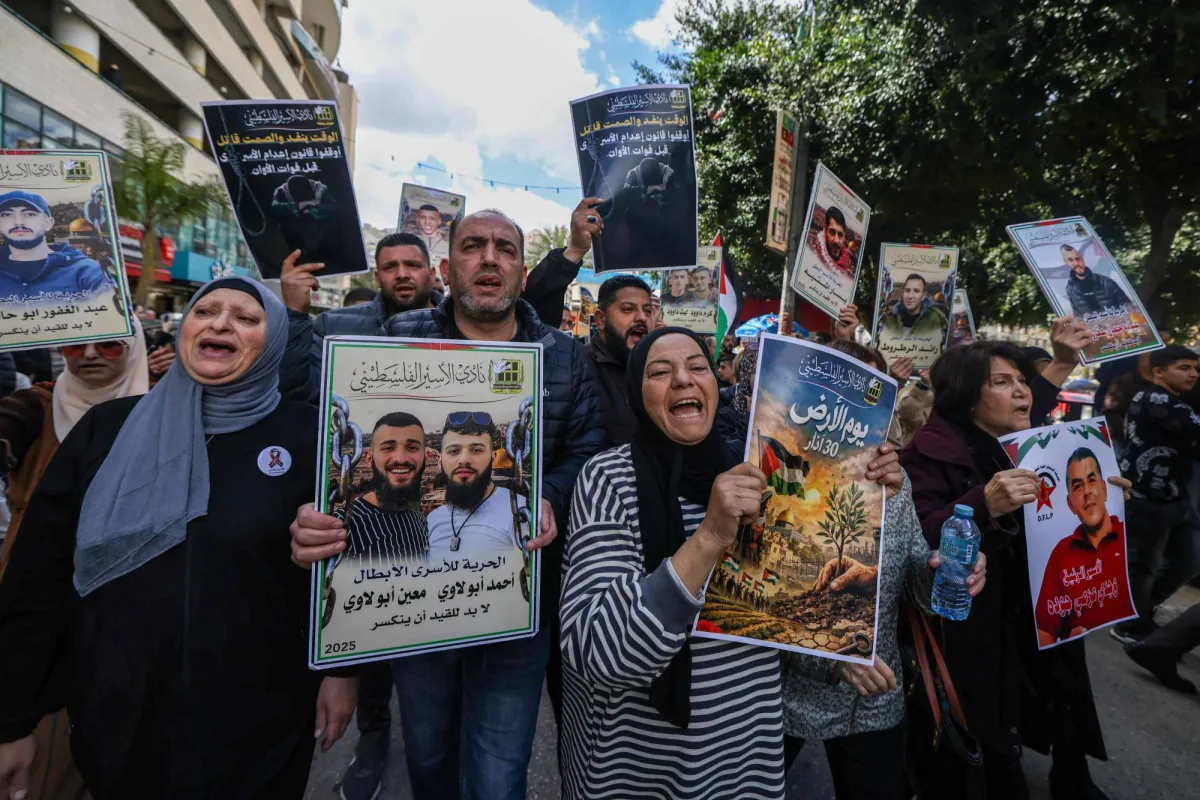
The Israeli Knesset's approval of a death penalty law for Palestinians convicted of terrorism has ignited anger and fear among the families of Palestinian detainees, who protested outside the International Committee of the Red Cross headquarters in Ramallah. This came after the Knesset voted with a majority of 62 votes in favor and 47 votes against the bill, which could allow for the execution of Palestinians convicted of terrorism-related charges.
Among the protesters was Maysoun Shawamreh, who held a picture of her son Mansour, detained in Israeli prisons for over three years without trial. Shawamreh expressed her concern, stating, "I am afraid for my son... The mothers of the prisoners could not sleep last night." She added, "He could be included in this decision, or he may not be."
Details of the Law
The new law stipulates that anyone who intentionally causes the death of another person with the intent to harm an Israeli citizen or resident, and with the intent to end the existence of the State of Israel, shall be punished by death or life imprisonment. For Palestinians in the occupied West Bank, the death penalty is considered the default punishment if Israeli military courts classify the act of killing as "terrorism."
Although the law does not apply retroactively, critics argue that it highlights an unequal judicial system, where Israel can impose the death penalty on any Palestinian who kills an Israeli citizen, while it cannot be applied to an Israeli who kills a Palestinian.
Context and Background
Historically, Israel has only carried out the death penalty twice: the first was in 1948 after the establishment of the state, and the second was against Nazi official Adolf Eichmann. Despite the existence of the death penalty in Israeli law, it has only been executed under very narrow circumstances and requires a unanimous decision from the judges, a condition that has never been met.
Following the law's approval, Israeli National Security Minister Itamar Ben Gvir celebrated in parliament, provoking angry reactions from various quarters. The United Nations has deemed the implementation of this law a potential "war crime," while human rights organizations argue that the law creates two parallel paths aimed solely at targeting Palestinians.
Reactions and Consequences
The Israeli decision has provoked widespread reactions from the Palestinian Authority and Arab and Islamic countries. The Palestinian Ministry of Foreign Affairs condemned the law, calling it "legislation for genocide," and urged for urgent international action to halt its implementation. The Arab League has also decided to convene a council meeting to discuss how to address Israeli crimes and violations.
Within Israel, opinions on the law vary; some view it as a significant step in combating terrorism, while others consider it a discriminatory and unacceptable measure. Several human rights organizations have filed petitions to the Israeli Supreme Court to annul the law, arguing that it contradicts Israel's basic laws that prohibit arbitrary discrimination.
Impact on the Arab Region
The enactment of this law represents a serious escalation in the Israeli-Palestinian conflict, reflecting the deteriorating human rights situation for Palestinians under occupation. Moreover, international reactions indicate growing concern over human rights violations in the occupied territories, which could exacerbate conditions in the region.
In conclusion, the approval of the death penalty law in Israel presents significant challenges for Palestinians and complicates the ongoing conflict, necessitating urgent international action to protect human rights and ensure justice.