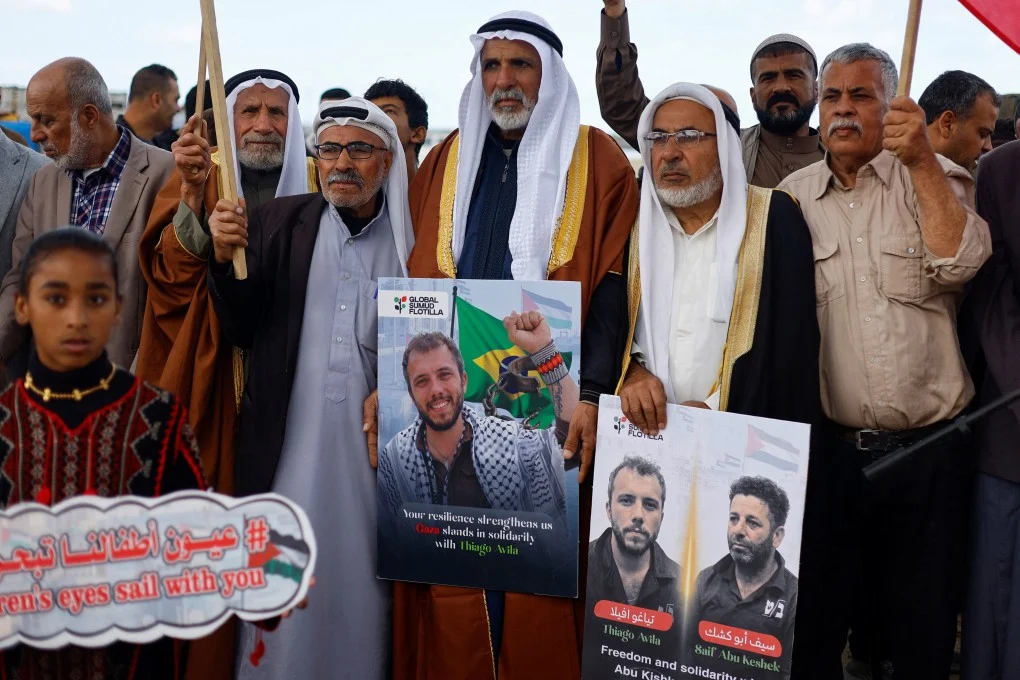
Israel has deported two activists, Saif Abu Kashik, a Spanish-Swedish citizen of Palestinian descent, and Thiago Avila, a Brazilian citizen, after detaining them for over a week near Greece. The activists were apprehended while leading a humanitarian fleet intended to break the naval blockade imposed on Gaza, which has sparked widespread reactions in human rights and political circles.
The activists, who are part of the Global Solidarity Fleet steering committee, were intercepted by the Israeli navy off the coast of Crete. Their detention was announced earlier, raising international concerns regarding human rights and freedom of expression.
Details of the Incident
The Israeli navy managed to intercept the fleet, which included dozens of activists seeking to deliver humanitarian aid to Gaza. The activists were held under harsh conditions, prompting many human rights organizations to demand their immediate release. After a period of detention, Israeli authorities decided to deport the activists back to their home countries.
This incident occurs at a sensitive time, as Gaza is suffering from a severe humanitarian crisis due to the ongoing blockade. The activists have indicated that their goal is to highlight the suffering of the Palestinian people and to lift the blockade imposed on Gaza.
Background & Context
Historically, the Middle East has witnessed numerous attempts to break the blockade on Gaza, which began in 2007 following Hamas's takeover of the territory. These policies have exacerbated the humanitarian situation in Gaza, where residents face acute shortages of essential supplies such as food and medicine.
Attempts to break the blockade are part of a global movement advocating for Palestinian rights, and in recent years, there has been an increase in the number of fleets attempting to reach Gaza. However, these efforts often face severe resistance from Israeli authorities, who view them as a threat to their security.
Impact & Consequences
This incident raises questions about freedom of expression and human rights in the context of the Israeli-Palestinian conflict. The detention and deportation of the activists reflect the challenges faced by global movements seeking to support Palestinian rights. Additionally, these events may lead to increased international pressure on Israel to ease the blockade on Gaza.
This incident is also a turning point in how the international community addresses human rights issues in Palestine, as it could result in greater support for activists striving to shed light on the suffering of the Palestinian people.
Regional Significance
These events are of significant importance to the Arab region, as they reflect the ongoing Israeli-Palestinian conflict and its impact on Arab countries. Supporting activists in breaking the blockade can enhance Arab solidarity with the Palestinian cause and encourage further grassroots movements to support Palestinian rights.
In conclusion, the Gaza issue remains at the core of Arab and international attention, and attempts to break the blockade continue as a means of expressing solidarity with the Palestinian people. Recent events highlight the urgent need for action to achieve justice and peace in the region.