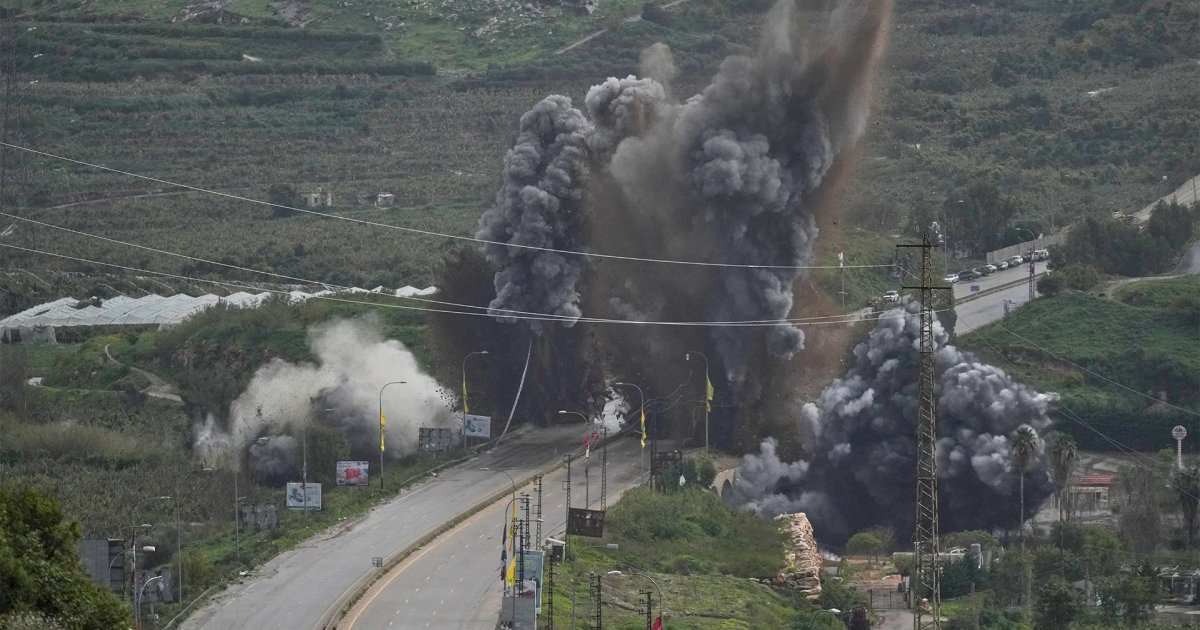
The Israeli occupying army continued its assaults on vital infrastructure in southern Lebanon, bombarding the Qasmiyah Bridge this Sunday evening. This action is part of what many observers are describing as the 'Bridge War,' aimed at undermining Hezbollah's capabilities and reinforcing Israel's presence in southern regions.
The Qasmiyah Bridge, located on the coastal road linking the cities of Sidon and Tyre, is considered one of the most critical arteries in the south, lying about 6 kilometers from Tyre and 30 kilometers from Sidon. The Israeli army targeted it after warning that it would attack to protect a strategy that disrupts the movement of supplies and military reinforcements for Hezbollah. This targeting effectively separates areas in southern Lebanon and restricts the movement of civilians between the northern and southern sides of the Litani River, raising fears of a worsening humanitarian situation.
An Israeli official clarified that the airstrikes are part of Israel's efforts to impede Hezbollah's movements, reflecting a military policy that Tel Aviv has been following for some time. The United Nations peacekeeping force (UNIFIL) and Lebanese authorities have urged residents in the areas near the bridge to evacuate their homes due to Israeli warnings.
The Qasmiyah area holds strategic importance not only for military considerations but also extends to humanitarian aspects. The area surrounding the bridge significantly contributes to the transport of food and medical supplies to the city of Tyre. With about 20% of the population remaining in the southern areas, these attacks could lead to a crushing living crisis for hundreds of thousands if the bombings persist and transport routes are severed.
In humanitarian terms, experts warn that conditions may become more complicated with increasing warnings of new strikes by the Israeli army, which seeks to implement what is known as a 'buffer security zone' in southern Lebanon—areas still bearing the scars of an occupation that lasted for decades.
Moreover, political science professor Abdullah Al-Shayji indicates that these attacks align with what is known as the 'madman theory,' used as a means to exert psychological and military pressure on adversaries, aiming to confuse Hezbollah and prompt concessions regarding its armament.
Al-Shayji noted that this strategy is not exclusive to Israel but can also be seen in previous policies of former U.S. President Donald Trump, who frequently used threats as a means to achieve his objectives without engaging in full-scale conflicts.
On March 2nd, southern Lebanon witnessed reciprocal attacks between Hezbollah and the Israeli army, with the party launching an attack on Israeli positions in response to the assassination of one of its leaders. These ongoing operations indicate a continuous deterioration in security conditions amid concerns of escalating conflict.
The situation in southern Lebanon is considered extremely sensitive, with pressures coming from all sides. The caution and military escalation from the Israeli side increase fears among civilians and leave grave humanitarian impacts. The near future holds much uncertainty and rising tensions between the conflicting parties, necessitating close monitoring of events to prevent crises from deepening.