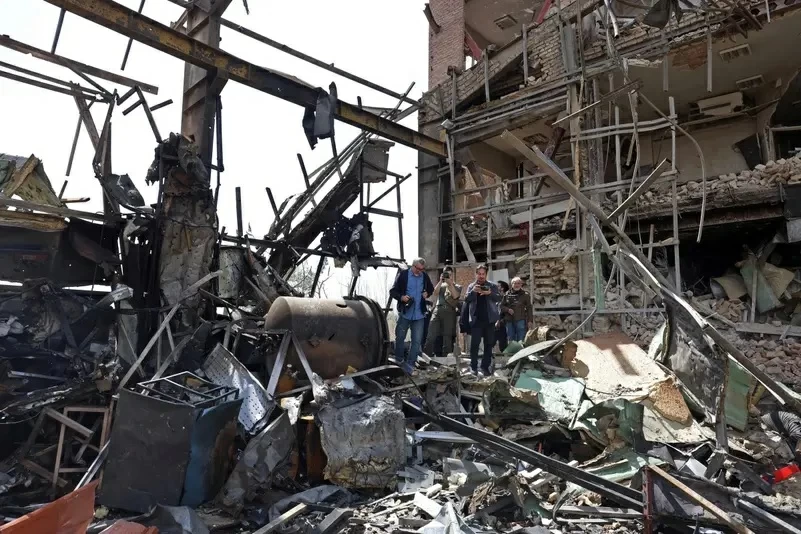
The ongoing war between Iran, the United States, and Israel has now reached its thirty-eighth day, with strong explosions reported at the South Pars petrochemical complex in Asaluyeh, according to the Iranian news agency "Fars." These developments come at a highly sensitive time as tensions escalate among the involved parties.
Israeli Defense Minister Israel Katz announced the targeting of Iran's largest chemical facility, confirming that Israel has managed to disrupt approximately 85% of Iran's petrochemical exports. This statement reflects Israel's strategy to undermine Iran's economic and military capabilities.
Details of the Incident
Circulating video footage showed the moment a munitions base belonging to the Iranian Air Force in Bushehr was targeted, resulting in a massive explosion with dense smoke rising into the sky. The International Atomic Energy Agency confirmed military impacts near the Bushehr nuclear power plant but reassured that the plant itself was not damaged.
In a related context, the city of Abadan in southwestern Iran was subjected to heavy strikes, as reported by local media. Another attack targeted a facility belonging to Sharif University of Technology in Tehran, leading to a temporary gas outage in some areas of the capital, where gas pressure reduction and measurement facilities were damaged.
Background & Context
The conflict between Iran and Israel dates back many years, with both countries exchanging accusations and launching attacks on each other's military and economic targets. The recent escalation comes at a critical time as Iran seeks to enhance its nuclear capabilities, while Israel attempts to prevent this by all available means.
Historically, Iran has sought to expand its influence in the region, raising concerns among neighboring countries, particularly Israel. This military conflict highlights the geopolitical tensions in the Middle East and reflects the ongoing challenges faced by the region.
Impact & Consequences
The mutual military strikes between Iran and Israel could lead to a greater escalation in the conflict, threatening regional stability. Targeting vital facilities may impact the Iranian economy and increase pressure on the Iranian government.
On the other hand, Iranian missile attacks on Israel indicate Iran's ability to respond, heightening tensions further. Reports of 4 fatalities in the city of Haifa due to an Iranian missile attack reflect the seriousness of the situation, as civilians become victims of the military conflict.
Regional Significance
This military escalation has significant implications for the Arab region, raising fears of new conflicts. Neighboring Arab countries may find themselves compelled to reassess their security strategies in light of these developments.
Furthermore, the continuation of this conflict could affect relations between Arab states and Iran, increasing divisions in the region. It is crucial for Arab nations to closely monitor the situation and take steps to mitigate the impacts of this conflict.
In conclusion, the situation in the Middle East remains complex, with political and military interests intertwining, making it difficult to predict the region's future. The current escalation may mark the beginning of a new phase of conflict, necessitating all involved parties to consider peaceful solutions to avoid further escalation.