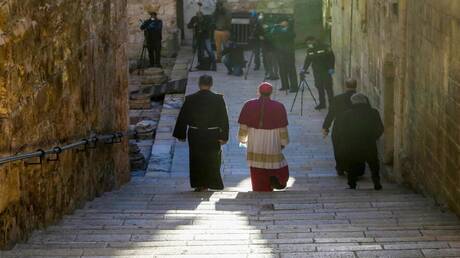
The Israeli Prime Minister's Office, led by Benjamin Netanyahu, announced that the decision to prevent Cardinal Pizzaballa, the Archbishop of Jerusalem for the Catholic Church, from entering the Church of the Holy Sepulchre in Jerusalem was "temporary." The office clarified that this decision was made as part of efforts to protect worshippers, based on allegations regarding Iran's targeting of holy sites.
This decision has sparked widespread reactions in religious and political circles, with many considering it an unjustified step that infringes on freedom of worship, especially in a site regarded as one of the holiest places in Christianity. Sources indicated that Cardinal Pizzaballa intended to visit the church to participate in religious celebrations, but his ban has caused significant discontent among the faithful.
Details of the Incident
In this context, Netanyahu's office confirmed that the decision was made following security assessments, indicating that there are potential threats targeting holy sites in Jerusalem. Israeli officials noted that Iran seeks to destabilize the region, necessitating precautionary measures to protect worshippers.
Despite this, the justification has not convinced many observers, who believe such decisions could exacerbate tensions between different religions in the holy city. Human rights organizations have called for a reconsideration of such policies that affect freedom of worship.
Background & Context
The Church of the Holy Sepulchre is considered one of the holiest Christian sites, believed to be the burial and resurrection site of Christ. This area has witnessed historical tensions over the ages, where political and religious interests intertwine. In recent years, concerns have escalated that political conflicts may impact freedom of worship in holy places.
It is noteworthy that relations between Israel and the Vatican have experienced tensions in the past, particularly regarding the rights of Christians in the Holy Land. The Catholic Church has sought to promote the rights of Christians in the region, making it a target for criticism from certain Israeli circles.
Impact & Consequences
The ban on Cardinal Pizzaballa from entering the Church of the Holy Sepulchre may provoke angry reactions from Christian communities and could lead to heightened tensions between religions in Jerusalem. Furthermore, this decision may affect relations between Israel and the Vatican, potentially negatively impacting efforts to promote interfaith dialogue.
Moreover, this incident could contribute to reinforcing negative narratives about Israeli policies towards religious minorities, which may increase international pressure on the Israeli government. This could lead to renewed calls for international intervention to protect the rights of minorities in Jerusalem.
Regional Significance
This event represents part of the larger picture of religious and political conflicts in the region. With escalating tensions between Israel and Arab countries, the ban on Cardinal Pizzaballa from entering the Church of the Holy Sepulchre could increase discontent in the Arab world, which may reflect on relations between Arab states and Israel.
At the same time, this incident highlights the importance of protecting holy sites and the rights of religious minorities in the region. Any violation of these rights could exacerbate crises and heighten tensions in the area.
In conclusion, the question remains as to how the international community will respond to these developments and whether there will be concrete steps to protect freedom of worship in Jerusalem. Recent events indicate the necessity of enhancing interfaith dialogue and working towards building bridges of trust among different communities.