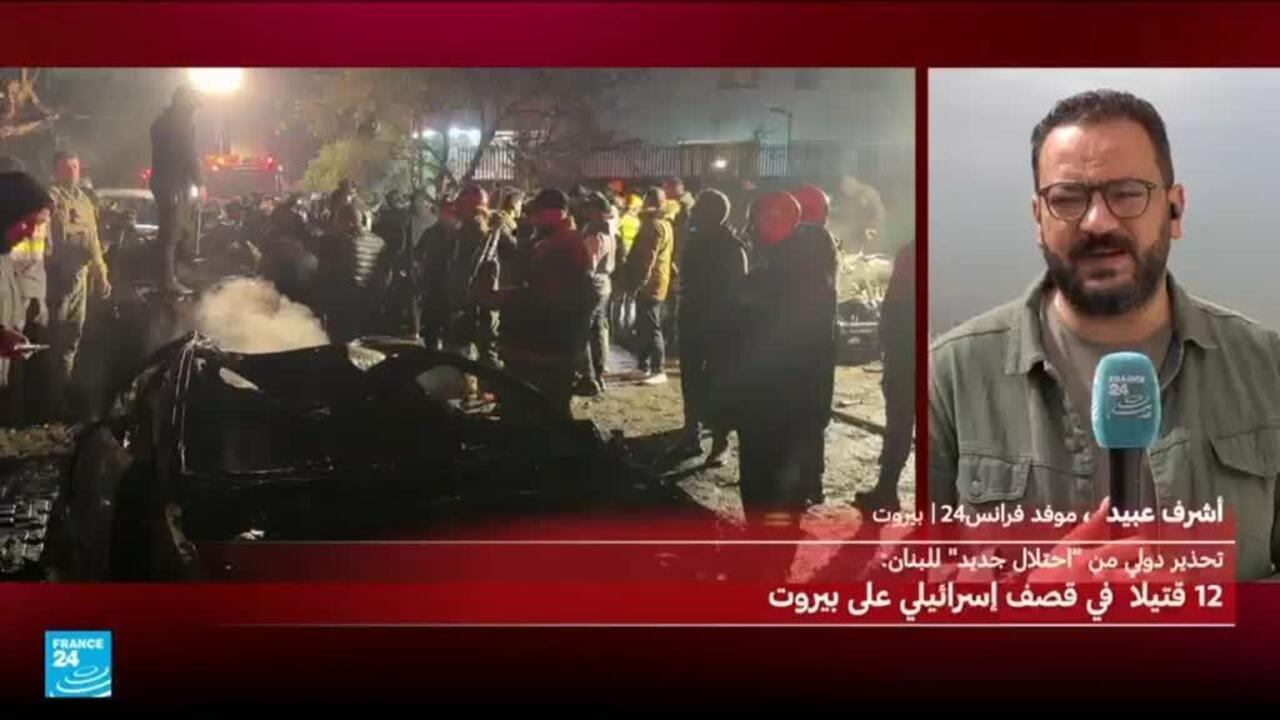
Israeli airstrikes in Beirut have resulted in the deaths of at least 12 individuals, targeting vehicles near the southern suburb. While the Israeli military announced it aimed at a high-ranking Hezbollah leader, a security source told AFP that the strikes in the Jnah area targeted four cars parked on a street.
In response to these airstrikes, Hezbollah announced a wave of attacks on northern Israel on Tuesday evening, targeting several towns and Israeli military, air, and naval bases with volleys of rockets. The group also stated that it engaged in three successive clashes with Israeli forces inside the town of Aynata, located about four kilometers from the border with Israel.
Details of the Incident
These airstrikes come at a sensitive time, as tensions between Israel and Hezbollah escalate, reflecting an intensification of the ongoing conflict. The airstrikes that occurred on Tuesday night targeted a densely populated area, leading to civilian casualties, which raises concerns within the international community regarding the military escalation in the region.
The Israeli military, for its part, confirmed that the aim of these airstrikes was to eliminate potential threats from Hezbollah, noting that the targeted leader played a prominent role in planning operations against Israel. This escalation occurs amid the tense atmosphere prevailing in the region, which requires a cautious response from all involved parties.
Background & Context
Historically, relations between Israel and Hezbollah have seen increasing tensions since the 2006 war, which resulted in heavy losses on both sides. Since then, both parties have continued to exchange attacks, complicating the security situation in Lebanon. Hezbollah, which is considered a terrorist organization by many countries, continues to bolster its military capabilities, while Israel seeks to maintain its security against increasing threats.
In recent years, the region has witnessed an escalation in armed conflicts, with regional and international dimensions intertwining in the struggle. Mutual attacks between both sides have increased, reflecting the ongoing instability in Lebanon and its impact on regional security.
Impact & Consequences
The recent escalation could lead to serious repercussions for regional security, potentially igniting a full-scale war between Israel and Hezbollah. This escalation may also affect the economic and social situation in Lebanon, which is already suffering from multiple crises.
International pressures on the involved parties may increase, as the international community seeks to mitigate the escalation and ensure regional stability. Should these attacks continue, international powers may intervene for mediation, potentially altering the dynamics of the conflict.
Regional Significance
The recent events reflect the ongoing tensions in the region, with neighboring Arab countries affected by the conflict between Israel and Hezbollah. This escalation could lead to increased division among various factions in Lebanon and impact relations between Arab countries and Israel.
Under these circumstances, Arab countries must be prepared to deal with the repercussions of any potential escalation, whether through diplomacy or by enhancing security cooperation. The stability of Lebanon is vital for regional security, and there must be joint efforts to ensure that the situation does not worsen.
In conclusion, the situation in Lebanon remains under observation, as tensions between Hezbollah and Israel are expected to continue affecting regional security. The international community must play an active role in attempting to calm the situation and ensure that the conflict does not escalate further.