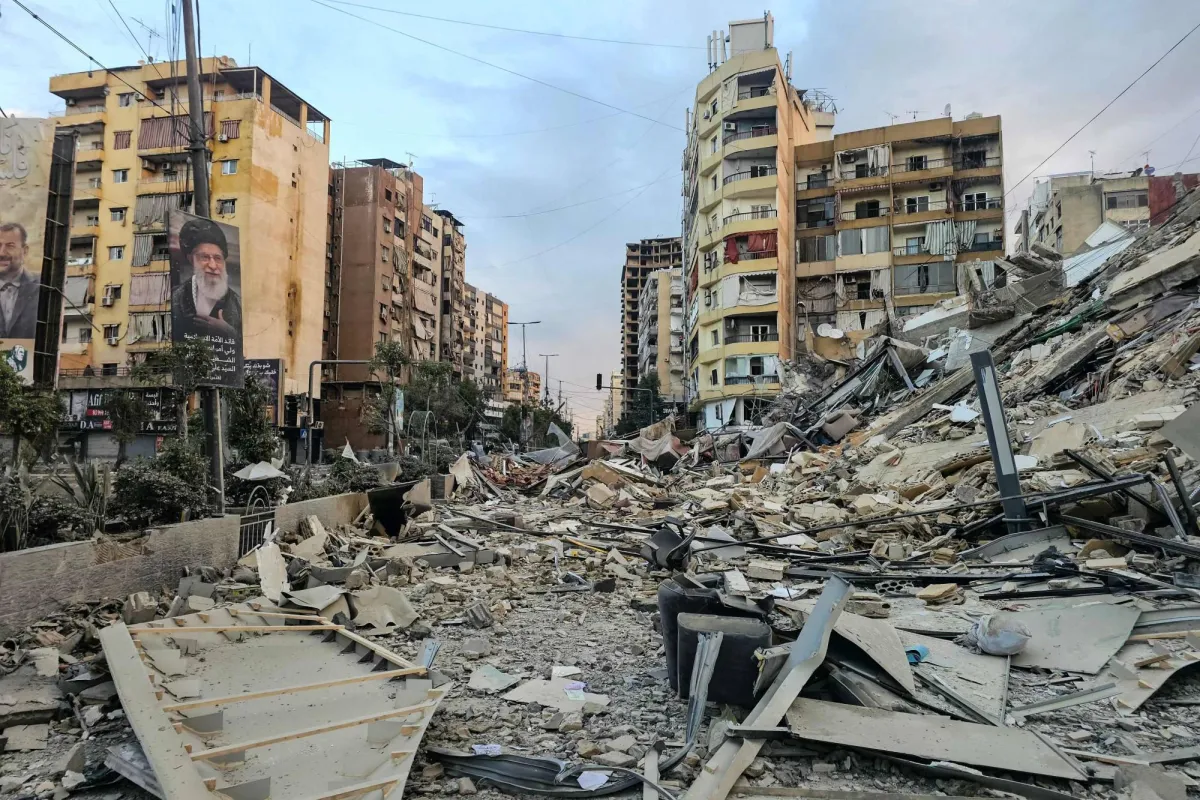
Israeli airstrikes on Lebanon continued today, targeting areas in the south and the southern suburbs of Beirut, where the Israeli military announced the deaths of two prominent members of Hezbollah's communications unit during separate airstrikes.
As confrontations intensify between the two sides, Hezbollah is ramping up its attacks against Israeli forces in border areas, with these confrontations nearing the completion of their first month.
Details of the Incident
Israel launched airstrikes on southern Lebanon early today, according to the National News Agency. The strikes targeted the towns of Majdal Selim, Kafra, Al-Haniyya, Tulin, and Adloun, as well as the city of Nabatiyeh, destroying several residential and commercial buildings and a fuel station.
In a tragic incident, five paramedics were killed due to an Israeli strike that targeted an ambulance belonging to the Islamic Scout Movement on the road to Zawtar Al-Sharqiya in the Nabatiyeh district. The Emergency Health Operations Center reported that another airstrike resulted in the martyrdom of one paramedic and injuries to four others.
On another front, the National News Agency reported strikes on border towns, particularly the town of Taybeh, amid an Israeli attempt to advance towards the Litani River area.
Background & Context
These airstrikes come as part of an escalating military confrontation between Israel and Hezbollah, with the Israeli military announcing the targeting of dozens of Hezbollah's infrastructure in recent hours. An airstrike in Beirut resulted in the death of Ayoub Hussein Yaqub, a prominent member of the communications unit, along with Yasser Muhammad Mubarak, who also held a position in the party's missile unit.
Through these operations, Israel aims to diminish Hezbollah's military capabilities, with strikes targeting weapon depots, launch platforms, and military buildings.
Impact & Consequences
Concerns are rising over the escalation of violence in the region, as Israel announces plans to expand its military operations in southern Lebanon, including establishing a security zone extending to the Litani River. This escalation could exacerbate the humanitarian situation in Lebanon, where civilians are suffering from the effects of ongoing bombardment.
In response, Hezbollah continues to target Israeli forces, announcing attacks on Israeli troop gatherings in Dibl, as well as shelling the command center of the Israeli army's northern region.
Regional Significance
Tensions in the Arab region are increasing due to these events, as Israeli airstrikes raise fears of a broader escalation that could affect the stability of Lebanon and neighboring countries. The continuation of these military operations may negatively impact relations between Arab countries and Israel, complicating peace efforts in the region.
In conclusion, the situation in Lebanon remains tense, with ongoing Israeli airstrikes and Hezbollah's escalation, signaling further violence and humanitarian suffering.