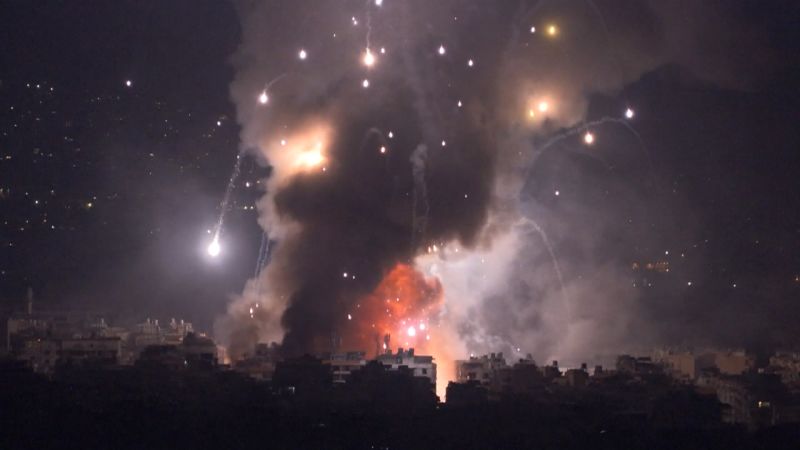
Israeli warplanes launched intensive airstrikes across various regions in Lebanon, including the suburbs of Beirut, the south, and the Bekaa Valley, causing significant material damage and increasing anxiety in the area.
These airstrikes come at a sensitive time, as tensions between Israel and Hezbollah are escalating, raising fears of a larger military escalation. Local sources reported that the strikes targeted sites believed to be affiliated with Hezbollah, resulting in widespread destruction of infrastructure.
Details of the Event
According to reports, the Israeli airstrikes began in the early hours of dawn, targeting several sites in the southern suburbs of Beirut, as well as areas in southern Lebanon and the Bekaa Valley. Local media observed columns of smoke rising from the targeted sites, while ambulances rushed to the affected areas to transport the injured.
Images circulated on social media showed the extent of the destruction, with many residential and commercial buildings damaged. Lebanese security sources confirmed that the airstrikes resulted in civilian casualties, further heightening the tension in the country.
Background & Context
These airstrikes occur amid rising tensions between Israel and Hezbollah, with recent exchanges of threats between the two sides. Hezbollah, which wields significant influence in Lebanon, is one of Israel's main adversaries in the region and has previously threatened to respond to any Israeli aggression.
Historically, relations between Lebanon and Israel have been fraught with ongoing tensions, especially following the Lebanese Civil War that lasted from 1975 to 1990. Since then, clashes between the two sides have continued, leading to repeated military escalations.
Impact & Consequences
Estimates suggest that these airstrikes could lead to a larger military escalation in the region, as Hezbollah may respond to these attacks with military operations against Israeli targets. Additionally, the escalation could impact the security situation in Lebanon, which is already grappling with economic and political crises.
Moreover, these airstrikes could increase tensions between Lebanon and Israel, threatening the stability of the entire region. Some countries have warned that any escalation could lead to serious humanitarian consequences, especially given the difficult economic conditions prevailing in Lebanon.
Regional Significance
These airstrikes are part of the ongoing conflict in the Middle East, which affects many Arab countries. The tensions between Israel and Hezbollah could have repercussions for regional security, as other groups may exploit the situation to increase their influence.
Furthermore, military escalation could affect peace efforts in the region, as some Arab countries seek to achieve lasting stability. In this context, the international community must intervene to prevent the situation from worsening and work towards peaceful solutions to the conflict.
In conclusion, the situation in Lebanon remains under close observation, as everyone awaits Hezbollah's reactions and whether these airstrikes will lead to a greater escalation in the conflict with Israel.