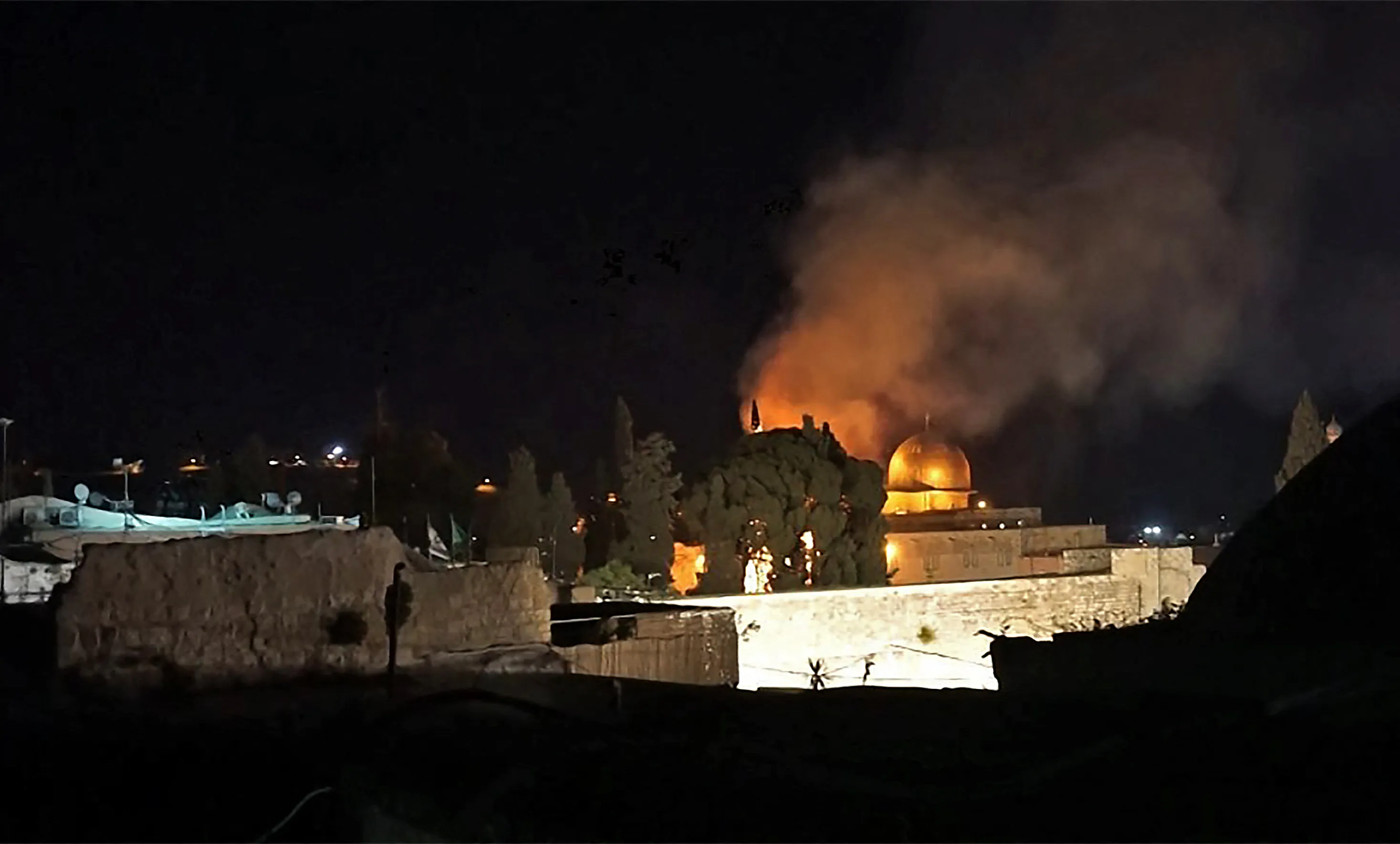
The Palestinian Ministry of Awqaf and Religious Affairs has revealed an "unprecedented" escalation in Israeli assaults on Islamic holy sites during March, indicating that both Al-Aqsa and the Ibrahimi Mosque have faced repressive measures aimed at imposing a new reality in Jerusalem.
The ministry's report clarified that Al-Aqsa Mosque has experienced continuous closures under the pretext of a "state of emergency," with the call to prayer being banned 68 times. It considered these actions part of a systematic policy aimed at reshaping the reality in the holy city.
Details of the Incident
The Ministry of Awqaf reported that the Israeli assaults coincided with the holy month of Ramadan, which heightened tensions in the region. It emphasized that the ongoing closure of Al-Aqsa Mosque and the Church of the Holy Sepulchre is no longer merely a security measure, but has become part of a strategy aimed at diminishing Palestinian presence in these sacred places.
The ministry also pointed out that these policies aim to impose actual sovereignty over the holy sites and alter their historical and legal character. The closure of the Old City of Jerusalem continues, preventing worshippers from accessing Al-Aqsa Mosque, which constitutes a violation of international law known as the "status quo."
Background & Context
The administration of Al-Aqsa Mosque is under the Islamic Waqf Department affiliated with the Jordanian Ministry of Awqaf, yet the occupying authorities are seeking various means to withdraw its powers. Recently, there has been an escalation in incitement by "Temple" groups, which utilize modern techniques to disseminate media materials simulating the destruction of Al-Aqsa Mosque.
In the city of Hebron, measures have been tightened at the gates of the Ibrahimi Mosque, leading to repeated bans on the call to prayer. Historically, this escalation traces back to the massacre committed by settler Baruch Goldstein in 1994, which resulted in the martyrdom of 29 worshippers.
Impact & Consequences
The Ministry of Awqaf asserts that these measures significantly affect freedom of worship, as worshippers have been prevented from entering Al-Aqsa to perform prayers, including the Eid al-Fitr prayer. This has been accompanied by an extensive deployment of occupation forces around the mosque, resulting in near paralysis of daily life.
The ministry also recorded an escalation in assaults on mosques in the West Bank, where a mosque in the town of Duma was set on fire. These assaults reflect a systematic policy aimed at isolating the holy sites and imposing a new reality that affects their religious status.
Regional Significance
These events are seen as indicators of rising tensions in the region, as Israeli policies impact relations between Palestinians and Israelis, exacerbating divisions within Palestinian society. Furthermore, these violations raise concerns among Arab nations and the international community regarding the future of Islamic holy sites.
In conclusion, the Ministry of Awqaf emphasizes that the Israeli escalation calls for Arab and international action to protect Islamic and Christian holy sites and ensure freedom of worship for all religions.