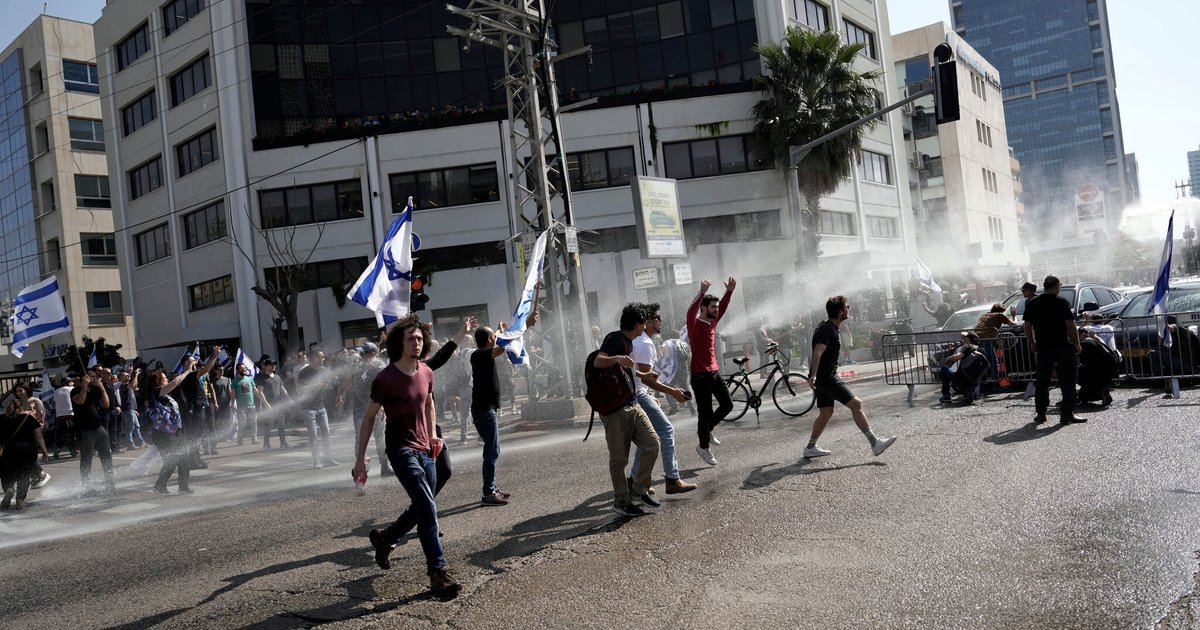
Israeli police employed sewage water to disperse a large protest outside the Knesset, in response to the controversial death penalty law for prisoners that has sparked widespread debate in political and social circles. The protesters, who gathered late last night, expressed their firm rejection of this law, asserting that it represents a violation of human rights.
This protest comes at a sensitive time, as the Israeli Knesset seeks to pass this law aimed at imposing the death penalty on Palestinian prisoners convicted of murder, which many view as a provocative step in the Israeli-Palestinian conflict.
Details of the Event
Thousands of protesters gathered outside the Knesset in Jerusalem, holding banners expressing their opposition to the new law. The demonstration saw a significant presence of human rights activists, who argued that this law contradicts international laws and human rights standards.
The Israeli police responded to the demonstrators by using sewage water, which drew widespread condemnation from human rights organizations. This action was deemed inhumane and an overreach in dealing with peaceful protesters.
Background & Context
Historically, Israel has seen numerous controversial laws related to the conflict with Palestinians. The death penalty law for prisoners is part of the current Israeli government's policy that adopts a strict approach towards Palestinians, especially following the escalation of violence in recent years.
If passed, this law could pave the way for further violations and increase tensions in the region. Many countries and international organizations have expressed concern over this trend, warning of the dire consequences that may ensue.
Impact & Consequences
The death penalty law for prisoners represents a provocative step that could exacerbate conditions in the Palestinian territories. Many fear that this law could lead to increased violence and protests, negatively impacting security and stability in the region.
This law could also affect Israel's relations with the international community, as the Israeli government is expected to face increasing pressure from countries advocating for human rights. This could lead to Israel's isolation on the international stage.
Regional Significance
These events are part of the ongoing conflict between Palestinians and Israelis, which directly affects security and stability in the Arab region. Arab countries are closely monitoring developments in the occupied territories, calling for the need to respect Palestinian rights.
At the same time, these events may enhance Arab solidarity with the Palestinian cause, as further supportive movements for Palestinian rights are expected in the near future, both at the grassroots and official levels.
The use of sewage water by Israeli police to disperse protesters reflects the rising repression against dissenting voices. As the debate over the death penalty law for prisoners continues, hope remains pinned on the international community to pressure for the respect of human rights in the occupied territories.