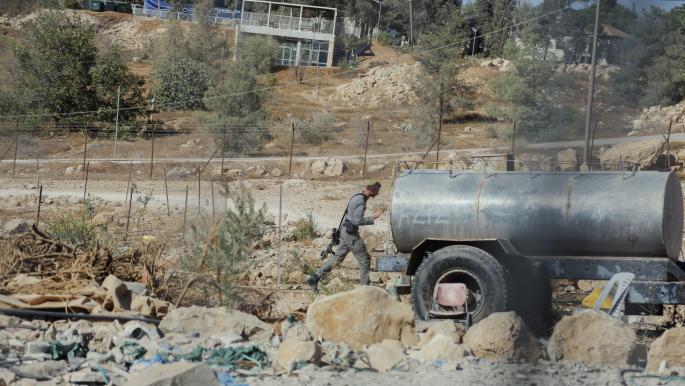
The risks to Palestinian productivity are increasing as settlement activity rises, with water sources becoming a primary target in a strategy aimed at undermining this capacity. This includes the destruction of pumping lines and sabotage of water tanks.
Tensions are escalating in the occupied Palestinian territories, as the Israeli occupation seeks to control natural resources, particularly water, which is considered the lifeblood of Palestinian agriculture and economy. In recent years, Palestinian agricultural areas have witnessed significant expansion of settlement activity, exacerbating the living conditions of Palestinian farmers.
Details of the Event
Reports indicate that the Israeli occupation has destroyed numerous water pumping lines serving Palestinian agricultural lands, negatively impacting agricultural production. Water tanks, which are essential for storing water, have also been sabotaged, increasing the suffering of farmers who rely on these resources to irrigate their crops.
Palestinian farmers assert that these actions are not random but are part of a systematic plan aimed at undermining their productive capacity. They emphasize that control over water is part of a broader strategy to reduce Palestinian dependence on natural resources, thereby contributing to the enhancement of settlement activities.
Background & Context
Historically, water has always been a focal point of conflict between Palestinians and Israelis. Since the Israeli occupation of the West Bank in 1967, strict restrictions on access to water have been imposed, exacerbating the water crisis in Palestinian areas. According to United Nations reports, Palestinians suffer from a severe water shortage, receiving less than 70 liters per person per day, while Israelis receive over 300 liters daily.
Water is a vital element in agriculture, which is one of the main sources of income in Palestine. As settlement activity increases, Palestinian agricultural lands are threatened, negatively impacting food security and the Palestinian economy as a whole.
Impact & Consequences
The repercussions of these policies extend beyond their direct impact on agriculture, also affecting the Palestinian community at large. With the destruction of water sources, Palestinians face significant challenges in securing their basic needs, leading to a worsening humanitarian situation in the region.
Moreover, these policies increase tensions between Palestinians and Israelis, enhancing instability in the region. Human rights organizations have warned that these actions constitute a violation of Palestinian rights and contribute to the exacerbation of humanitarian crises.
Regional Significance
These events point to a broader crisis concerning natural resources in the Arab region. With increasing tensions over water, it becomes essential for Arab countries to cooperate in sustainably managing water resources. The water crises in Palestine may serve as a model for what could occur in other parts of the Arab world, where pressures on water resources are rising due to climate change and population growth.
Ultimately, the current situation requires urgent international action to protect the rights of Palestinians to access water and ensure the sustainability of natural resources in the region. Addressing these issues is not solely the responsibility of Palestinians but a collective responsibility that requires concerted efforts at both regional and international levels.