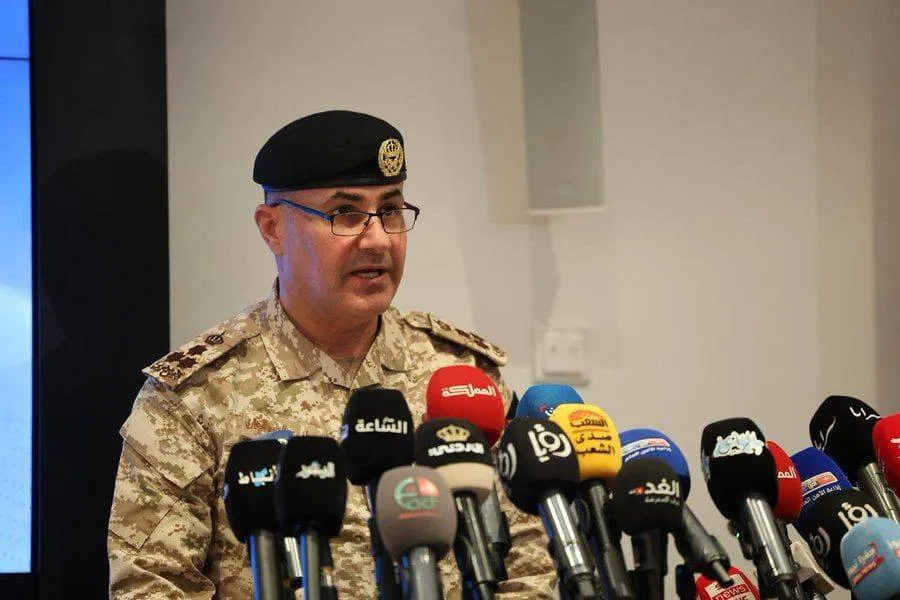
Jordan's military spokesperson, Brigadier Mustafa Al-Hiyari, revealed that air defenses have successfully dealt with 281 Iranian missiles and drones aimed at the kingdom's territory during a period of five weeks marked by military escalation in the region. He noted that out of these attacks, 261 were successfully intercepted, while the air defenses were unable to counter 20 missiles and drones.
Al-Hiyari emphasized that these assaults represent a violation of Jordan's sovereignty, stressing that the armed forces are working to prevent infiltration and smuggling attempts that may exploit the current security conditions.
Details of the Incident
In a related announcement, the Public Security Directorate reported that it has responded to 585 reports of incidents involving falling debris from missiles and shrapnel across various governorates, resulting in material damage to 59 homes and 31 vehicles, in addition to recording 28 injuries, most of which were minor and the individuals have since left the hospitals.
During a press briefing, Brigadier Al-Hiyari disclosed that the failure rate of ballistic missiles is 15%, increasing the likelihood of them landing on Jordanian territory, while the failure rate for cruise missiles is 25%, indicating a higher probability of them falling within Jordan's borders.
Context and Background
These warnings come amid escalating Iranian direct targeting of vital sites in Jordan. Al-Hiyari confirmed that the armed forces engage with missiles and drones immediately upon detection, especially in residential areas, due to their low-altitude flight paths.
He pointed out that the Engineering Corps of the armed forces has deployed over 30 teams across various governorates to handle falling objects, affirming that a decrease in the frequency of attacks does not diminish the level of threat, particularly regarding drones.
Impact and Consequences
Brigadier Al-Hiyari stated that the armed forces are executing defensive missions under Operation Shield of Jordan, aimed at protecting the homeland and preventing any loss of life. He explained that Iran and some factions in the region are directly targeting Jordanian territory without justification.
He also noted that the armed forces operate under a professional defensive doctrine that prioritizes civilian protection, and that the Jordanian state is highly prepared to deal with various scenarios.
Regional Significance
Concerns are growing over escalating tensions in the region, as these assaults pose a threat to regional security. The Iranian military escalation reflects new challenges for Jordan, which seeks to maintain its stability and security.
In conclusion, Jordan remains on high alert to confront any potential threats, while enhancing military and defense cooperation with brotherly and friendly nations to ensure the protection of its airspace.