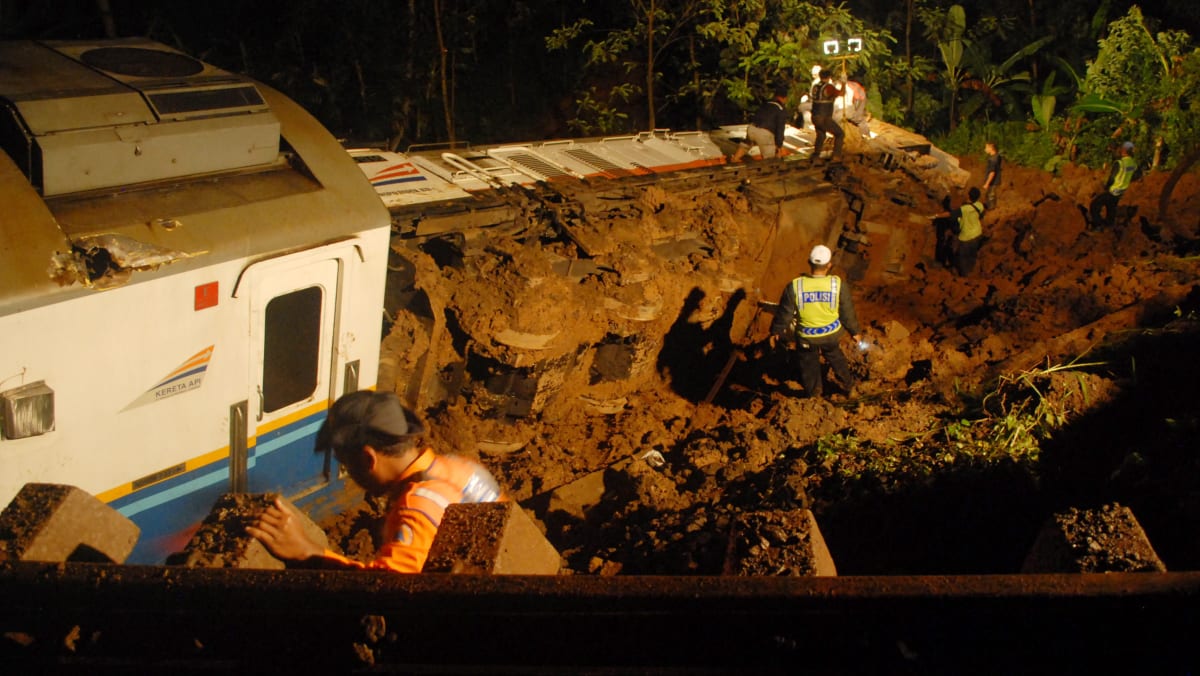
The Indonesian railway management (PT KAI) announced the suspension of the Ciremai train, which connects the cities of Semarang and Bandung, due to a landslide that occurred in the Maswati area. This incident led to the evacuation of passengers to buses to continue their journey. The accident happened on Wednesday, as the track was completely closed after the displaced soil caused the train to derail.
PT KAI confirmed that all passengers and crew members were in good condition following the incident, as all necessary measures were taken to ensure their safety. In this context, the Public Relations Director of PT KAI, Kuswardojo, stated that "the safety of passengers was the top priority during the handling of this incident."
Details of the Incident
The landslide resulted in the closure of the track in the Maswati area, leading to significant adjustments in the train schedules. Three Parahyangan train services were canceled, in addition to partial cancellations of other services such as the Harina train, Papandayan train, and Serayu train. The Ciremai train and Commuter Line Garut services were also canceled.
The railway management expressed deep regret to passengers for any inconvenience this incident may have caused, as teams of technicians were deployed to the site to remove debris and displaced materials from the track with the aim of restoring train operations as quickly as possible.
Background & Context
Indonesia is one of the countries facing significant challenges due to landslides, particularly in mountainous regions. These natural phenomena occur as a result of climate change and heavy rainfall, leading to soil erosion and increased landslide risks. In recent years, the country has witnessed numerous similar incidents that have affected transportation.
Historically, Indonesia has been prone to such natural disasters, prompting the government to enhance railway infrastructure and develop early warning systems. However, much work remains to be done to ensure passenger safety.
Impact & Consequences
This incident may affect passenger confidence in the railway system, as train transport is a preferred means of travel between major cities in Indonesia. This incident is expected to lead to a comprehensive review of safety procedures and preparedness for natural disasters.
Moreover, the adjustments in train schedules may have economic impacts on the transportation sector, as many people rely on trains for their daily commutes. It is crucial for the railway management to take effective steps to restore confidence and improve the services provided.
Regional Significance
Although the incident occurred in Indonesia, it highlights the importance of addressing natural disasters worldwide. Many Arab countries also face similar challenges, especially in mountainous or coastal areas. Arab nations can benefit from Indonesia's experiences in enhancing infrastructure and emergency planning.
In conclusion, Arab governments should take these incidents into account and work on improving transportation systems and public safety, contributing to the protection of lives and the promotion of sustainable development.