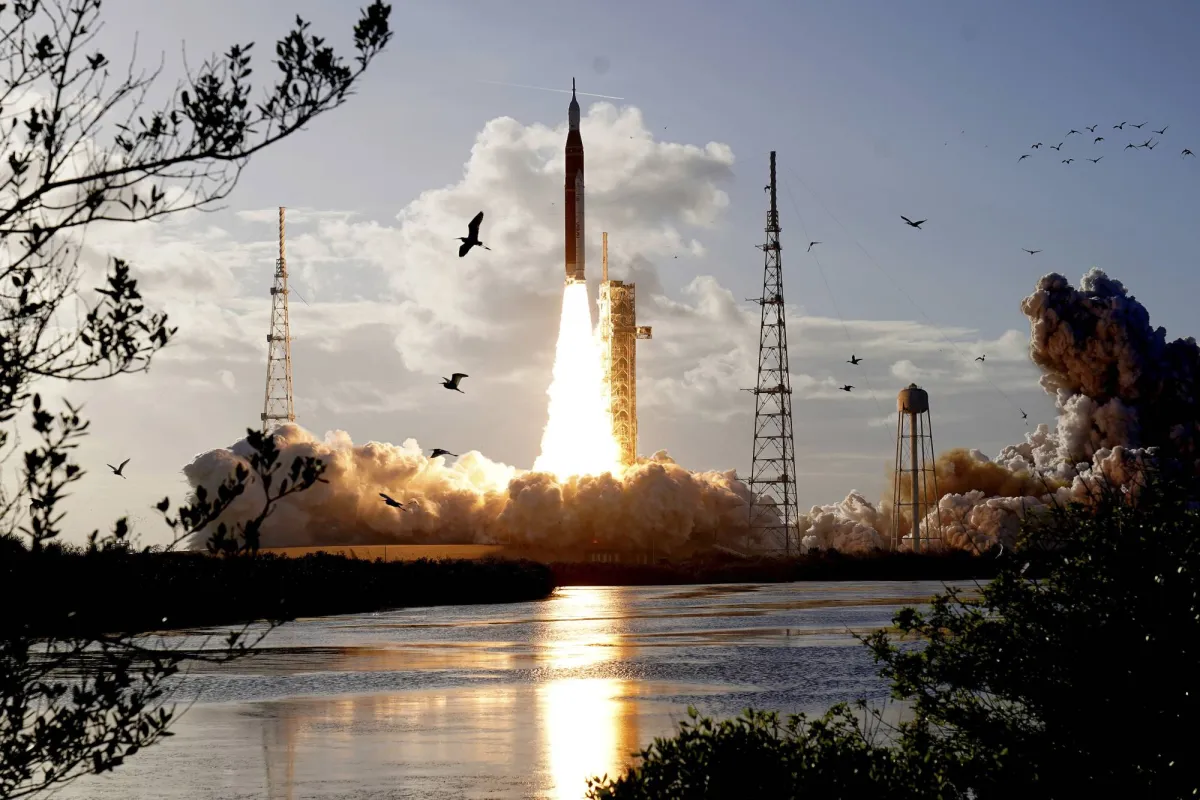
NASA, the United States' space agency, launched the crewed Artemis 2 mission on Wednesday to explore the Moon, marking a return for the U.S. to the forefront of space competition after 54 years since the last crewed mission around the Moon. The mission includes four astronauts, three of whom are American and one Canadian, and will last for ten days, aiming to orbit the Moon.
This mission comes at a time when China's efforts in space exploration are accelerating, with Beijing aiming to achieve ambitious goals including landing on the lunar surface by 2030. The Chinese Chang'e program, which began in 2004, has achieved notable milestones, including an uncrewed landing on the Moon in 2013 and a landing on its far side in 2018.
Event Details
The Artemis 2 mission represents a test step toward building a future lunar base, as the Orion spacecraft carrying the astronauts will conduct thorough checks on life support, navigation, and communication systems. In the early days of the mission, systems will be tested in a high Earth orbit before entering lunar orbit.
During the journey, the astronauts will examine their space suits and biometric signals to ensure their safety in the space environment. Subsequently, the Orion spacecraft will cross the far side of the Moon, marking the longest distance traveled in crewed spaceflight history.
Background & Context
Through the Artemis project, the United States aims to enhance its presence in space, especially following China's significant advancements in this field. The administration of former President Donald Trump had pushed for U.S. efforts to return to the Moon, setting a target for a landing on its surface by 2028.
However, NASA has faced delays in executing its plans, prompting a reassessment of the timeline for its space projects. The current agency director, Jared Isaacman, emphasized the importance of building trust and reducing risks through more launches to test components.
Impact & Consequences
The Artemis 2 mission is a strategic step in the context of global space competition, as both the United States and China seek to establish bases around the Moon's south pole. Both countries hope to extract resources such as frozen water, hydrogen, and helium, which are essential for supporting future deep space missions.
This competition may accelerate innovations in space technology, benefiting humanity as a whole. It also raises questions about international cooperation in space amid increasing geopolitical tensions.
Regional Significance
Although the Arab region is not at the center of this space competition, developments in space could open new avenues for Arab cooperation in technology and scientific research. Arab countries could benefit from the experiences and knowledge generated by these space missions.
In conclusion, the Artemis 2 mission represents a new beginning in space exploration, as major countries seek to enhance their presence in deep space, potentially impacting the future of international space.