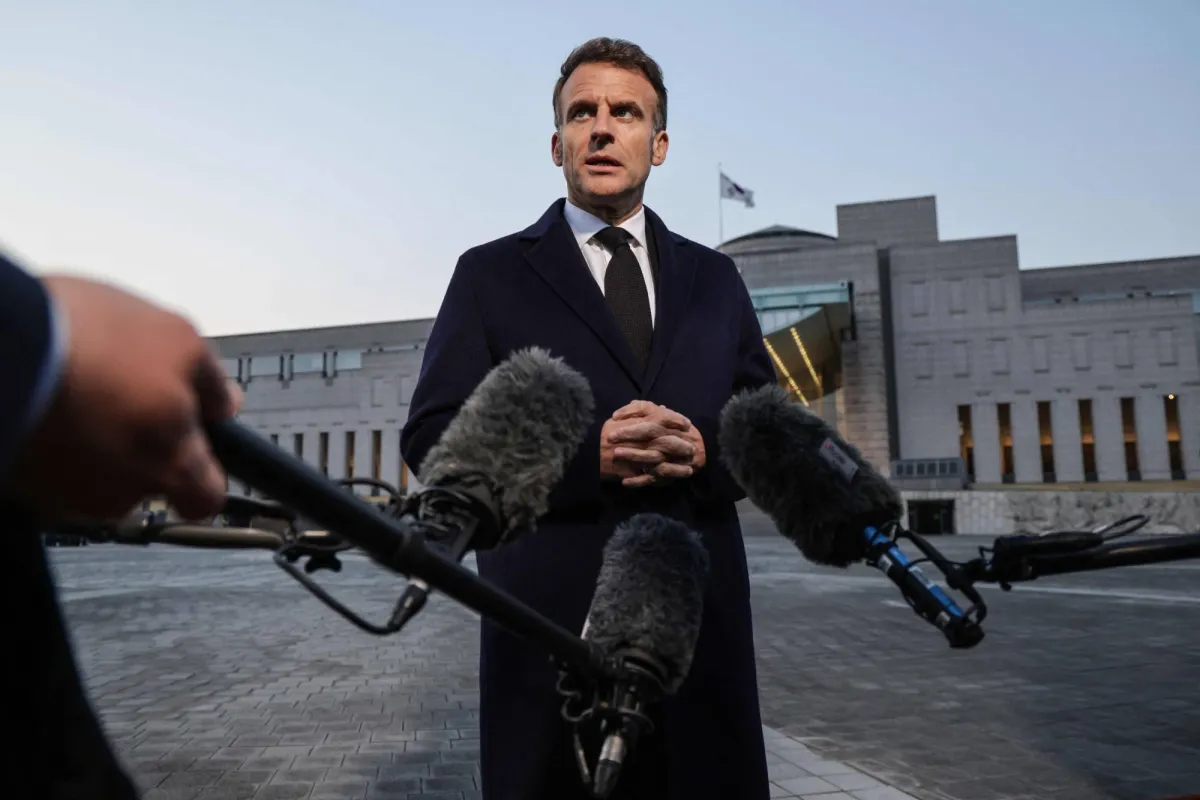
French President Emmanuel Macron, during an official visit to Seoul, asserted that the war waged by the United States and Israel against Iran will not resolve the issue of the Iranian nuclear program. Macron called for the necessity of conducting "in-depth negotiations" to address this crisis.
Macron explained to reporters that "a targeted nuclear action, even if it lasts for a few weeks, will not provide a permanent solution to the nuclear issue." He noted that the absence of a framework for diplomatic and technical negotiations could exacerbate the situation within months or years.
Details of the Event
Macron's statements come at a sensitive time as approximately 36 countries gather to diplomatically and politically pressure for the reopening of the Strait of Hormuz, which has seen its navigation affected due to the US-Israeli war against Iran. British Prime Minister Keir Starmer confirmed that the virtual meeting, chaired by British Foreign Secretary Yvette Cooper, aims to assess all possible measures to restore freedom of navigation and ensure the safety of ships and sailors.
These developments occur amid escalating tensions in the region, where Iranian attacks on commercial vessels have led to a near-total halt of navigation in the vital corridor linking the Gulf to the rest of the world's oceans, negatively impacting global oil prices.
Background & Context
Historically, Iran has been at the center of numerous nuclear crises, as Western countries, led by the United States, seek to prevent Tehran from developing nuclear weapons. In recent years, there have been multiple attempts to reach a nuclear agreement, but these efforts have often stalled due to political disagreements.
In this context, Macron deemed the remarks of his American counterpart, Donald Trump, regarding his wife as "inappropriate," indicating that such comments do not deserve a response. Trump had referred to what he described as poor treatment from Brigitte Macron towards her husband.
Impact & Consequences
The implications of these statements and current events extend beyond bilateral relations, affecting stability in the Middle East. The increasing tensions could lead to military escalation, threatening regional and international security.
Furthermore, the continued closure of the Strait of Hormuz, a vital artery for oil flow, could result in rising crude prices, impacting the global economy. In this context, the British Defense Minister confirmed that the UK has deployed additional air defense systems to counter "random Iranian attacks," reflecting the growing concern over Iranian threats.
Regional Significance
The Arab countries neighboring Iran, such as Saudi Arabia and the United Arab Emirates, are among the most affected by the current tensions. The ongoing conflict may negatively impact security and stability in these countries, necessitating urgent diplomatic moves to resolve the crisis.
In conclusion, hope remains pinned on diplomacy as the sole means to achieve peace and stability in the region, as the current situation requires joint efforts from all concerned parties.