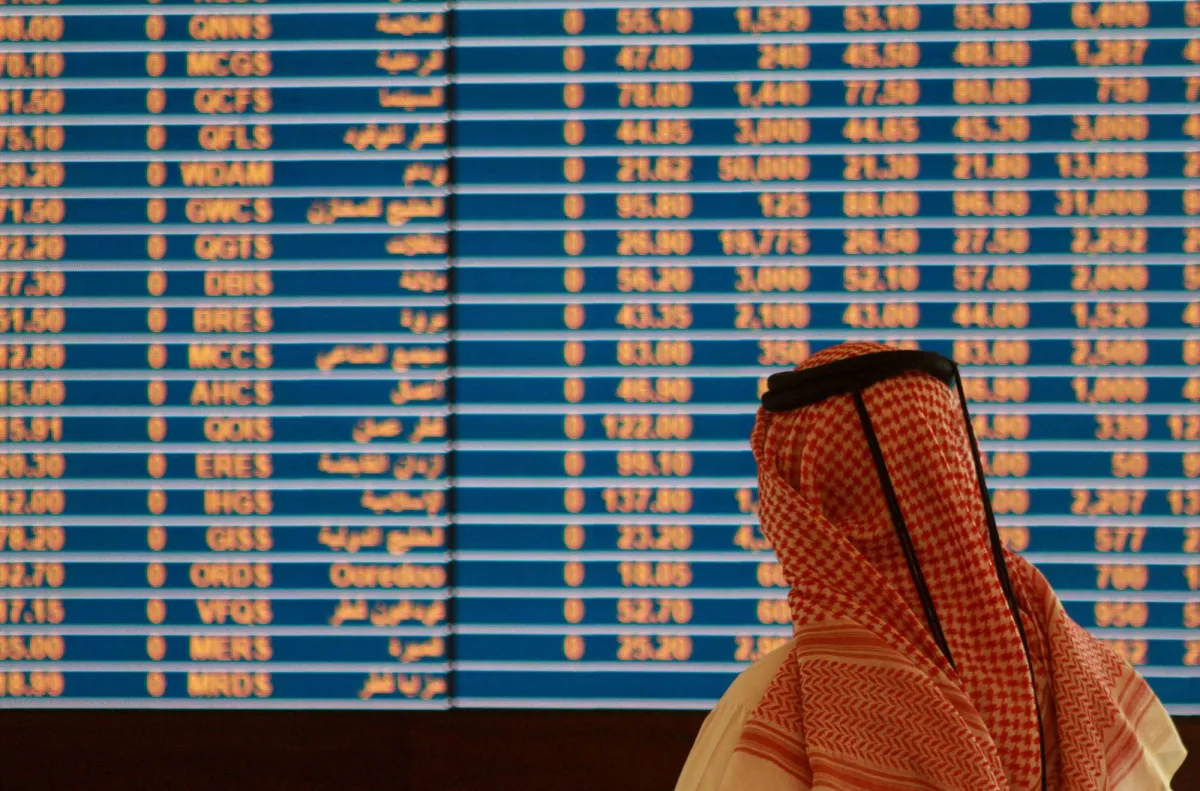
The main Gulf markets ended their trading on Monday with a clear divergence, as some markets saw declines while others recorded gains. This performance disparity comes as investors await further clarity on reports related to the ceasefire talks between the United States and Iran.
In the Saudi market, indices fell by 0.1% to close at 11263 points, with total trading values reaching approximately 4.5 billion riyals. The share of "Aramco" experienced a slight decline of less than 1%, closing at 27.50 riyals, while "Aqua" shares dropped by more than 1% to 165.90 riyals. Additionally, "Riyad Bank" shares fell by 2% to close at 21.44 riyals, and "Eastern Cement" shares dropped by 3% to 23.57 riyals after the dividend distribution eligibility period ended.
Market Performance Overview
In other Gulf markets, the Dubai Financial Market declined by 0.68%, while the Bahrain Stock Exchange fell by 0.02%. Conversely, the "Abu Dhabi Securities Exchange" recorded an increase of 0.26%, and the Kuwait Stock Exchange rose by 1.14%. The Muscat Securities Market saw a slight increase of 0.01%, while the Qatar Stock Exchange surged by 1.83%.
In a related context, the CEO of the Istanbul Financial Center reported that the Iranian war has prompted many companies operating in the Gulf to consider relocating some of their operations to the new state-supported financial center in Istanbul. This center features a cluster of glass towers that opened three years ago, housing the central bank and state-owned lending institutions, and offers incentives such as tax exemptions for companies during the first ten years.
Background & Context
These developments come at a time when the region is witnessing escalating regional tensions, as Iran has responded to U.S.-Israeli attacks by targeting objectives in the Gulf. Some financial firms in the region have instructed their employees to work from home, while HSBC has closed all its branches in Qatar until further notice.
Discussions are ongoing with companies from Malaysia, Japan, Singapore, South Korea, and Hong Kong, as institutions seek to assess potential areas of cooperation with government ministries and legislators from these countries. Erdem noted that regional developments have increased communications with companies, with appointments set for around 15 meetings with potential firms before the war.
Impact & Consequences
Markets expect these tensions to influence investment flows in the region, as companies aim to make strategic decisions regarding their operational locations. This may lead to a restructuring of supply chains in the area, potentially altering the dynamics of the financial market in the Gulf.
Moreover, the rising tensions may drive some companies to seek alternative markets, enhancing the significance of new financial centers like the Istanbul Financial Center. This shift could contribute to boosting investments in Turkey and increase its competitiveness as a regional financial hub.
Regional Significance
These events serve as a warning for many Arab countries that rely on foreign investments, as regional tensions may impact the stability of financial markets. Additionally, shifts in corporate strategies could lead to changes in economic relations between Arab countries and Turkey.
In conclusion, it remains to be seen how these developments will affect Gulf markets in the coming days and whether they will lead to permanent changes in investment strategies in the region.