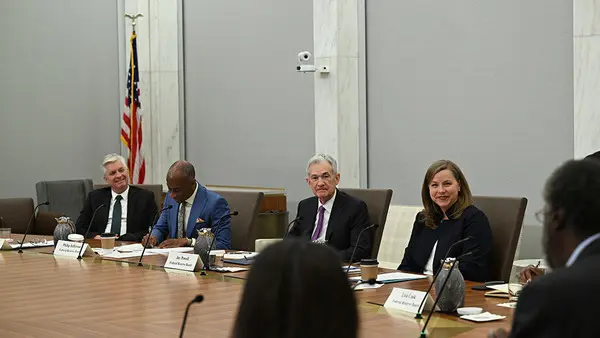
Global financial markets are currently facing considerable price volatility, with traders reassessing their expectations regarding interest rate cuts by the U.S. Federal Reserve. This shift in expectations occurs in the context of uncertainty surrounding ongoing global conflicts, as confirmed by Kay Herr, an investment manager at JPMorgan Asset Management, during her remarks on the program Bloomberg Surveillance.
Herr noted that traders are reacting erratically to global news and developments, leading to sharp fluctuations in the markets. These price changes serve as an indicator of how geopolitical events impact economic decisions, especially given the rising tensions in multiple regions around the world.
Event Details
In the current circumstances, investors are re-evaluating their financial positions, with some expecting the Federal Reserve to cut interest rates in the near future. However, the uncertainty arising from military and political conflicts may influence these expectations, keeping the markets in a state of constant vigilance.
Kay Herr's statements serve as a warning to investors about the necessity of exercising caution in their investment decisions, as the current volatility could lead to significant losses if not managed carefully. Additionally, financial markets react swiftly to any new information, further increasing the instability.
Background & Context
Historically, financial markets have been significantly affected by geopolitical events, where any escalation in conflicts can lead to a decline in market confidence. For instance, markets experienced sharp declines during previous crises such as the 2008 global financial crisis and the 2010 European debt crisis.
Currently, this existing crisis is compounded by uncertainty due to ongoing conflicts in the Middle East and Europe, complicating the global economic landscape. These conditions require investors to be more cautious and to closely monitor developments.
Impact & Consequences
The current fluctuations in the markets could have significant effects on the global economy, as any changes in interest rates can impact investments, employment, and economic growth. If the Federal Reserve decides to lower interest rates, it could stimulate the U.S. economy; however, it may also raise concerns about inflation.
Moreover, the prevailing uncertainty could lead to a decline in foreign investments in the United States, which may affect the value of the U.S. dollar and increase pressures on financial markets. Therefore, investors need to carefully assess risks before making any investment decisions.
Regional Significance
The Arab region is directly affected by global economic developments, as any changes in U.S. interest rates can influence investment flows to Arab countries. Should interest rates be lowered, this could encourage an increase in foreign investments in the region, potentially stimulating economic growth.
However, the uncertainty stemming from geopolitical conflicts may lead to a decline in confidence in Arab markets, making it essential for Arab governments to take steps to enhance economic stability and attract investments.
In conclusion, under the current circumstances, investors remain in a state of constant vigilance, as any changes in the monetary policies of the U.S. Federal Reserve could significantly impact global financial markets, including Arab markets. The current situation requires everyone to be prepared to adapt to rapid changes.