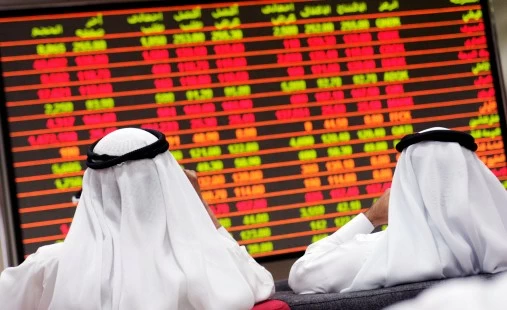
Gulf stock markets closed with notable divergence as investors await developments in ceasefire talks between the U.S. and Iran. This follows President Donald Trump's warning to Tehran of severe consequences if it does not reopen the Strait of Hormuz.
Brent crude futures recorded a decline of 0.33%, or 36 cents, reaching $108.67 per barrel. This drop reflects the geopolitical uncertainty impacting the markets, prompting investors to hesitate in making decisions.
Market Performance Overview
The performance of the Gulf Cooperation Council (GCC) markets varied, with the Saudi benchmark index falling by 0.1%, while Dubai's main index dropped by 0.7%, influenced by a 3% decrease in Emaar Properties' stock. Conversely, Abu Dhabi's index rose by 0.3%, and the Qatari index saw an increase of 1.8%, supported by a 1.6% rise in Qatar National Bank's shares.
The Bahraini and Omani indices remained stable, while the Kuwaiti index climbed by 1.1%. Outside the Gulf region, Egypt's leading stock index increased by 0.8%.
Background & Context
In a social media post, Trump warned that he would order strikes on Iranian power stations and bridges if Tehran did not reopen the strategic waterway (Strait of Hormuz). This warning comes at a sensitive time, as the U.S. and Iran have received a framework plan to end hostilities, but Tehran has refused to reopen the strait immediately.
The significance of the Strait of Hormuz lies in its role in global trade, with approximately 20% of the world's oil passing through it. Any tension in this vital corridor could lead to rising oil prices and impact global markets.
Impact & Consequences
Concerns are growing over a potential military escalation in the region, which could negatively affect economic stability in Gulf countries. Investors in financial markets are directly impacted by these developments as they seek to assess potential risks.
If uncertainty persists, we may witness greater volatility in the markets, potentially leading to a decline in confidence in investments. Additionally, any military escalation could affect oil prices, reflecting on oil-dependent economies in the region.
Regional Significance
These developments are of great importance to the Arab region, as many countries are affected by fluctuations in oil prices. Any escalation in tensions between the U.S. and Iran could lead to widespread repercussions, including increased commodity prices and negative impacts on economic growth.
In light of these circumstances, it is crucial for Arab countries to remain vigilant and work towards enhancing their economic and political stability to avoid any adverse effects that may arise from these crises.