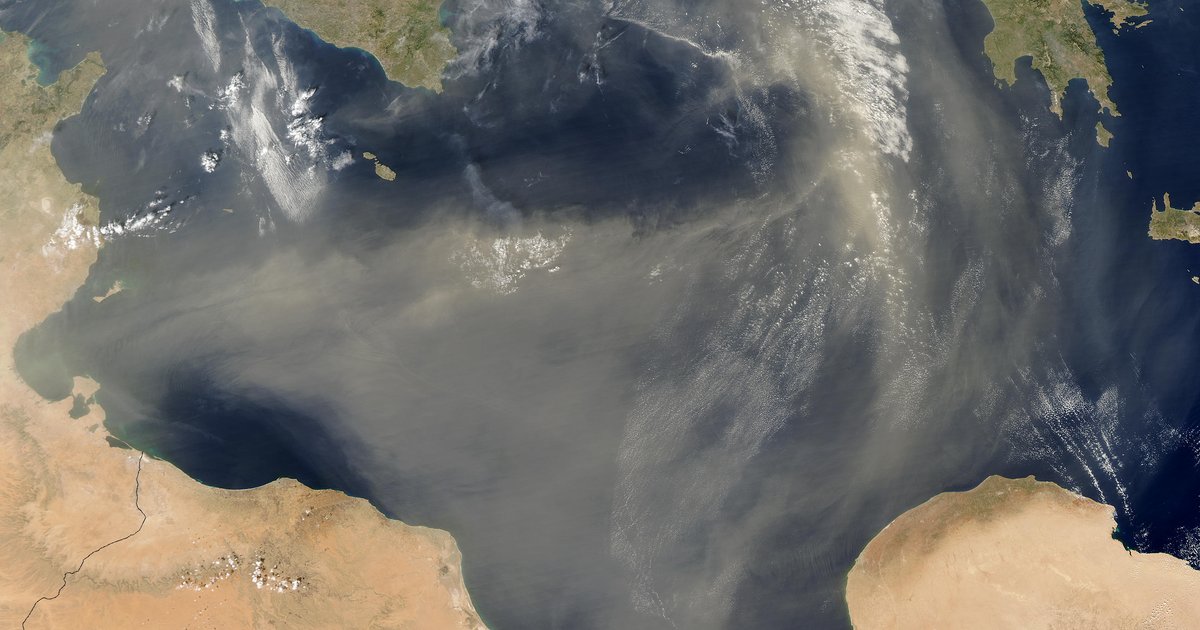
Recent weather reports indicate that a massive dust wave originating from the Libyan desert has swept across 11 countries, driven by active winds towards the eastern Mediterranean. Affected nations include Egypt, Sudan, Chad, Greece, Cyprus, Jordan, Palestine, Syria, Lebanon, Saudi Arabia, and Iraq.
Studies suggest that the impact of the Libyan desert on dusty atmospheres is not a sporadic event but rather a recurring climatic pattern. A previous study published in 1982 revealed that approximately 70 million tons of desert dust move annually from the Sahara towards the eastern Mediterranean, with about 23 million tons successfully reaching the coasts after traveling distances of up to 2000 kilometers.
Details of the Event
About 20 years ago, another British study illustrated the movement of dust from Libya, indicating that North Africa is the largest global source of desert dust, with the Libyan Sahara contributing nearly half of the dust deposited in the world's oceans. Research has shown that Libya is not only a source of dust but also a gathering area for airborne particles.
Studies indicate that dust deposition rates in certain Libyan regions are among the highest compared to other areas in North Africa, reflecting Libya's capacity to produce dust. Research confirms that the majority of the dust settles within the first 2000 kilometers from its point of origin, making it a pivotal area in dust movement.
Background & Context
The peak activity of dust typically coincides with the spring and summer seasons, periods characterized by active southern and southwesterly winds that push massive amounts of dust from North Africa, through Libya, to the eastern Mediterranean and the Levant. Satellites have accurately monitored this phenomenon.
Recent studies, which rely on long-term data analysis, are crucial for understanding the movement of desert dust. A modern scientific index has been developed to monitor dust movement across the Mediterranean, aiding in understanding how these waves transform into extensive regional phenomena.
Impact & Consequences
Research shows that the thermal difference between air masses plays a critical role in driving dust storms. Hot air causes winds to move towards cooler air masses in the northern Mediterranean, resulting in strong winds capable of carrying vast amounts of sand and dust over long distances.
With anticipated climate changes, these storms may increase, as rising temperatures and increased aridity in North Africa are expected to enhance the winds' capacity to carry dust, making dust storms more severe and widespread.
Regional Significance
This phenomenon is of great importance to the Arab region, as it affects air quality and public health. The recurrence of these dust waves may also impact economic and agricultural activities in the affected countries.
In conclusion, understanding these climatic phenomena and their effects on the environment and public health is crucial, necessitating further research and studies to address future challenges.