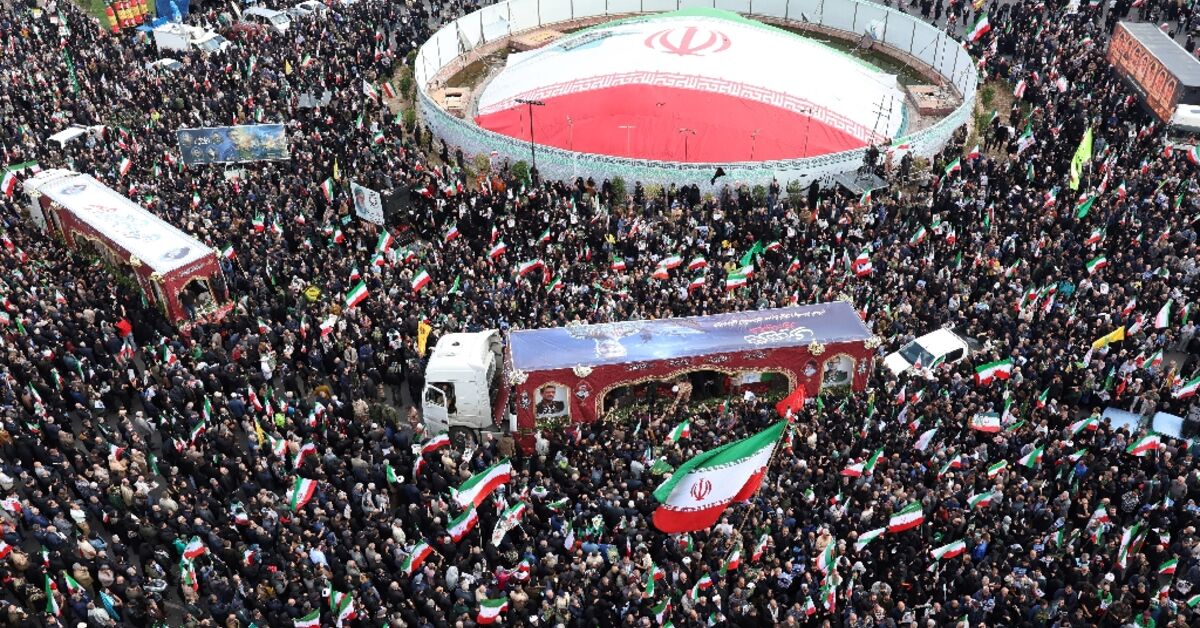
Thousands of Iranians gathered on Wednesday in Tehran to attend the funeral of the commander of the Iranian Revolutionary Guard Corps (IRGC) Navy, who was killed in an Israeli airstrike. The participants pledged to continue fighting until the end despite harsh statements from Washington.
This ceremony coincided with the 47th anniversary of the establishment of the Islamic Republic, which was declared on April 1, 1979, following the revolution that overthrew the last Shah and ended over 2,500 years of monarchy. However, this year, the occasion carried special significance as Tehran faces major challenges under ongoing U.S. and Israeli bombardment since February 28.
Event Details
The funeral procession began in central Tehran, where participants carried images of the late commander and flags of the Islamic Republic, chanting slogans calling for resistance and steadfastness. Images circulated on social media showed massive crowds, reflecting significant public support for the IRGC amid the difficult circumstances the country is experiencing.
These events come at a sensitive time as Iran is experiencing military escalation from Israel, increasing tensions in the region. Many observers have pointed out that this airstrike is part of an Israeli strategy aimed at undermining Iranian influence in the area.
Background & Context
The Islamic Republic of Iran was established in 1979 after a popular revolution that overthrew Shah Mohammad Reza Pahlavi, who was supported by the West. Since then, Iran has become a key player in regional politics, seeking to enhance its influence in the Middle East by supporting its allies in Iraq, Syria, and Lebanon.
Over the years, Iran has faced numerous challenges, including economic sanctions imposed by the United States, which have exacerbated the country's economic situation. Nevertheless, the IRGC remains widely supported by the public, as many view it as a symbol of resistance against external pressures.
Impact & Consequences
These events raise questions about the future of Iranian-Israeli relations, as the recent airstrike is expected to escalate tensions in the region. Many analysts have warned that Iran may take retaliatory steps, potentially leading to greater military escalation in the area.
Additionally, these events may impact Iranian domestic politics, as officials might exploit this tragedy to bolster their position among the populace, which could lead to increased support for the IRGC in the face of external challenges.
Regional Significance
Arab countries are significantly affected by Iranian-Israeli tensions, as many view Iran as a threat to their national security. Concerns have grown that escalating tensions could lead to new conflicts in the region, negatively impacting regional stability.
At the same time, these events may strengthen alliances between some Arab countries and Israel, as both sides seek to counter Iran's growing influence. Thus, developments in Iran could have far-reaching effects on regional politics.
In conclusion, events in Iran remain a focal point for the world, reflecting ongoing conflicts in the region and the challenges faced by countries amid changing geopolitical conditions.