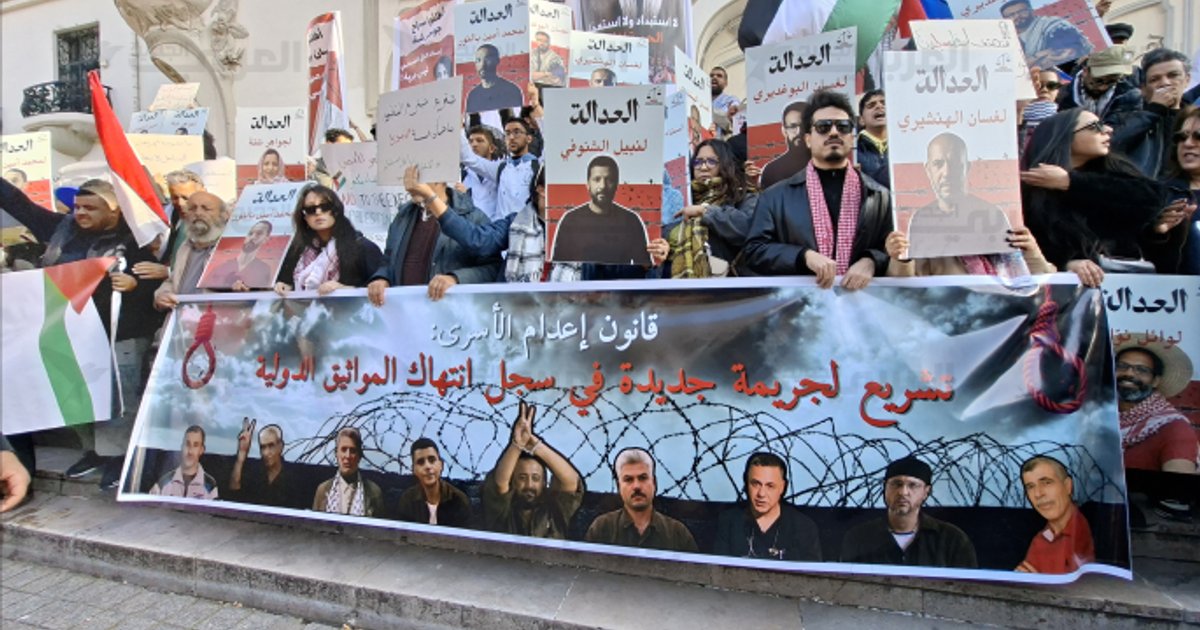
A large demonstration took place on Saturday evening in Habib Bourguiba Street, Tunis, organized by the 'Resilience Committee' and other activists, calling for the release of detained activists from the Freedom Fleet. Participants gathered in large numbers, holding banners expressing their demands and chanting slogans calling for the immediate release of the detainees.
This march comes at a time of increasing political and social tensions in Tunisia, as activists seek to highlight issues of human rights and public freedoms. Speakers at the march emphasized the importance of solidarity with the detainees, stressing the need to respect their legal and human rights.
Details of the Event
The march began at 6 PM, with participants gathering in Martyrs' Square before heading towards Habib Bourguiba Street. There was a noticeable security presence in the area, but this did not prevent the demonstrators from freely expressing their demands. Participants raised slogans such as 'Release them' and 'Freedom for all detainees', indicating their support for the rights of the detainees.
Leaflets were distributed outlining the circumstances under which the Freedom Fleet activists were arrested, with reports indicating that they were detained for participating in activities related to humanitarian and human rights issues. Many demonstrators expressed concern over the deteriorating human rights situation in Tunisia, calling on the government to take responsibility in this regard.
Background & Context
The events surrounding the Freedom Fleet date back to previous attempts by human rights activists to highlight humanitarian issues in conflict areas. In recent years, Tunisia has witnessed numerous popular movements demanding freedom and democracy, especially following the revolution that ousted the Ben Ali regime in 2011. However, significant challenges still face civil society, including arbitrary arrests and restrictions on freedom of expression.
The 'Resilience Committee' is one of the organizations striving to defend the rights of detainees, established as part of civil society organizations' efforts to raise awareness of human rights in Tunisia. The committee has played an important role in organizing events and activities aimed at supporting detainees and their families.
Impact & Consequences
This march comes at a sensitive time for Tunisia, as pressure on the government from local and international human rights organizations is increasing. These popular movements could influence the government's stance on human rights issues and may push it to take positive steps towards improving conditions.
This demonstration is expected to elicit reactions from the international community, as many human rights organizations are closely monitoring the situation in Tunisia. International pressure may raise awareness about human rights issues in the country, potentially contributing to improving the legal conditions for detainees.
Regional Significance
Tunisia is seen as a model in the Arab region, with the Tunisian revolution of 2011 marking a turning point in the path of democracy in the Arab world. However, the ongoing human rights violations in Tunisia may negatively impact hopes for democratic transitions in other countries. Supporting activists and civil society in Tunisia could have a positive influence on similar movements in other Arab nations.
In conclusion, this massive march in Tunisia reflects the commitment of civil society to human rights and highlights the importance of solidarity with detainees. The continuation of these popular movements may contribute to enhancing public freedoms and human rights in the country.