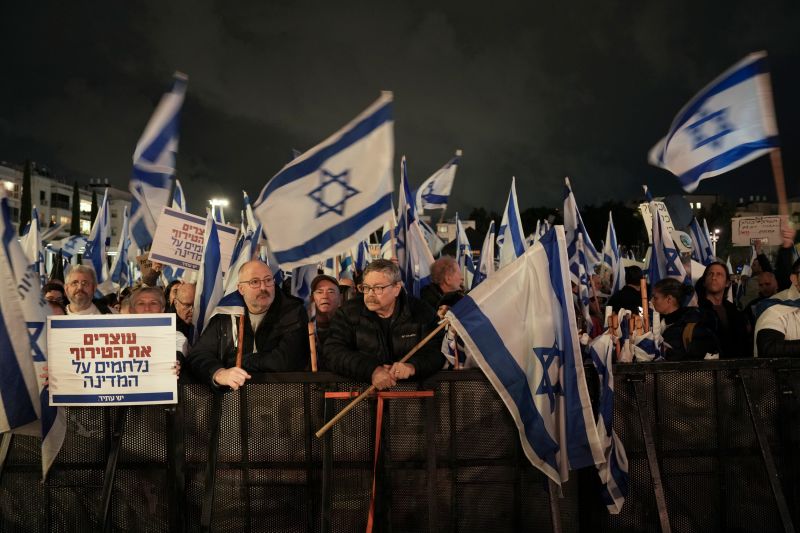
On Saturday, the Israeli city of Tel Aviv saw massive protests as more than a thousand demonstrators gathered in Rabin Square, expressing their opposition to a potential war with Iran and Hezbollah. These protests occur at a sensitive time, as the security situation in the region is escalating, increasing concerns among Israeli citizens.
In a related context, U.S. President Donald Trump confirmed during a press conference that he has set a deadline of April 6 for reaching an agreement with Tehran, warning that failure to secure a deal could lead to the reopening of the Strait of Hormuz, one of the world's most crucial waterways.
Details of the Protests
The protests come amid growing fears of escalating military tensions in the Middle East, with increasing pressure on the Israeli government from its citizens who express concern over the repercussions of any potential conflict. Protesters held signs calling for peace and denouncing war, emphasizing the importance of diplomatic solutions.
At the same time, Trump did not address the fate of the American pilot reported missing after his plane was shot down over Iranian airspace, further complicating the situation. This uncertainty regarding the pilot's fate reflects the increasing tensions between the United States and Iran, adding pressure on the U.S. administration.
Background & Context
Historically, relations between the United States and Iran have been strained since the Iranian Revolution in 1979. These tensions have escalated in recent years, particularly after the U.S. withdrawal from the Iranian nuclear deal in 2018. Since then, Washington has imposed strict sanctions on Tehran, exacerbating the economic and political situation in Iran.
The presence of Hezbollah in Lebanon, which is backed by Iran, remains a constant source of concern for Israel. In recent years, there have been several confrontations between the two sides, increasing the likelihood of military conflict in the region. The protests in Tel Aviv reflect public anxiety over these tense conditions.
Impact & Consequences
The current developments could lead to military escalation in the region, potentially affecting both regional and global security. If an agreement with Iran is not reached, the likelihood of war may increase, impacting oil prices and global financial markets.
Moreover, any military escalation could lead to a flow of refugees into neighboring countries, increasing the burden on these nations and affecting their stability. Additionally, military tensions could impact relations between Arab states and Iran, further complicating the regional landscape.
Regional Significance
The developments in U.S.-Iranian relations have a direct impact on Arab countries, especially those sharing borders with Iran or directly affected by regional conflicts. Gulf states, for instance, are closely monitoring these developments, as any escalation could affect their security and stability.
Furthermore, the situation in Lebanon, where Hezbollah is present, could be significantly impacted by any military escalation. Tensions between Israel and Hezbollah could lead to widespread conflict, threatening security in Lebanon and neighboring countries.
In conclusion, the situation in the Middle East remains complex, with overlapping regional and international interests. The protests in Tel Aviv reflect public anxiety over war, while the United States continues to pressure Iran. There remains hope that diplomatic solutions will prevail to avoid further escalation.