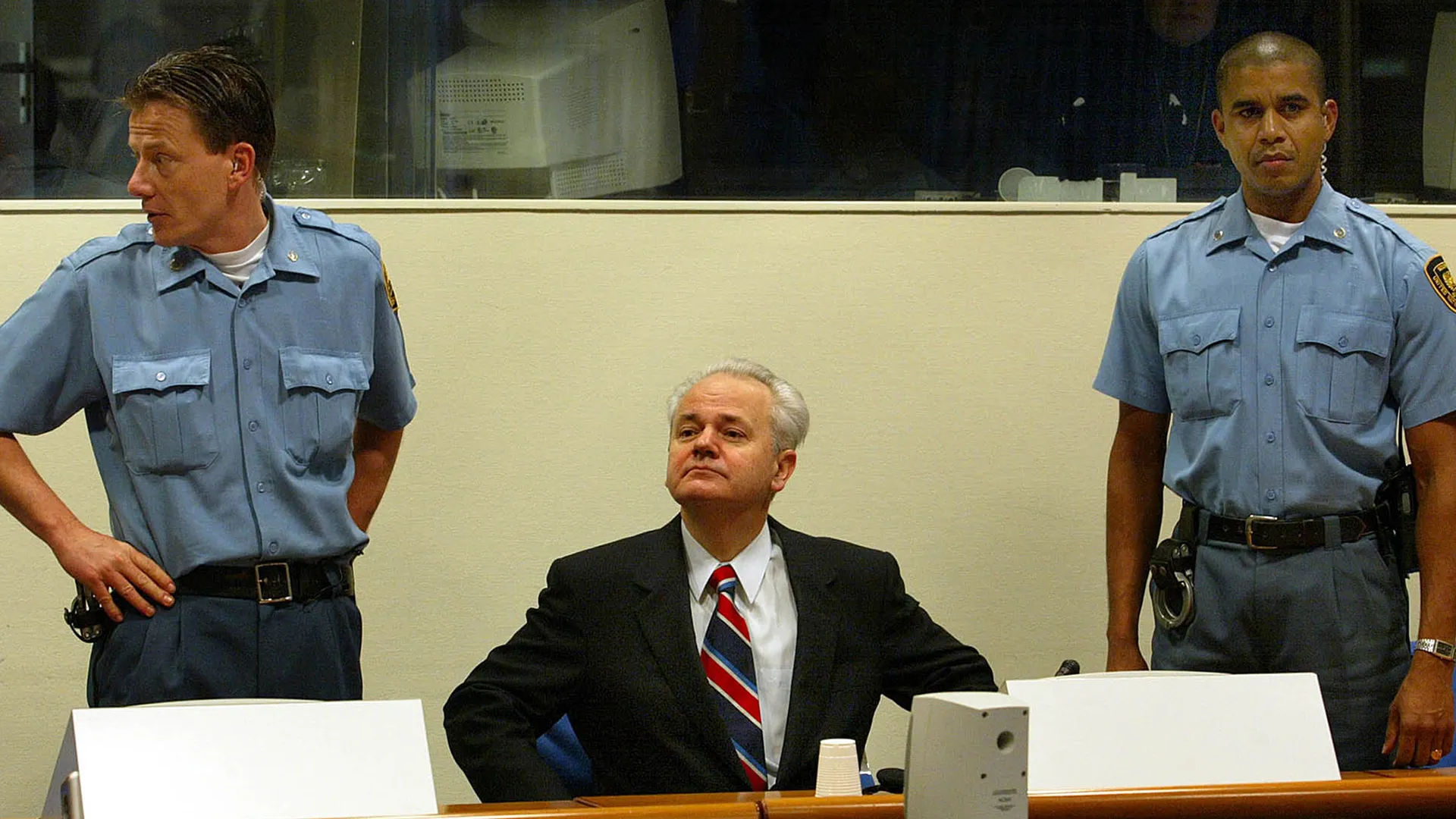
In cell number 11, the life of Slobodan Milosevic, known as the "Butcher of the Balkans," came to an end, leaving behind a bloody legacy and a judicial file burdened with 66 charges. His trial at the International Criminal Tribunal for the former Yugoslavia in The Hague was not merely a legal procedure but a fierce confrontation between international justice and the legacy of the ethnic wars he ignited.
The episode of the program "Trials," aired on April 2, 2026, highlighted intriguing details from Milosevic's trial, where he refused to appoint a lawyer, believing himself to be the most qualified to defend his case. He used his health condition as a means of manipulation, with sessions being adjourned 22 times due to his high blood pressure.
Details of the Event
In a dramatic confrontation, Prosecutor Carla Del Ponte accused him of attempting to kill her, sarcastically asking, "Do you want to try me while I'm in a coma? Or does justice not require the accused's consciousness?" These statements reflect the psychological turmoil Milosevic experienced during the trial, which turned into a battleground of psychological conflict.
The episode reviews the political roots of Milosevic, who transformed from an obedient communist cadre to an extremist nationalist leader. His friends and foes witnessed this transformation, with his old friend Ivan Stambolic facing him, stating, "Principles do not feed people... power does, and your time is over." Milosevic used the Kosovo dossier to fuel Serbian nationalism, which helped solidify his absolute power.
Background & Context
The crimes committed by Milosevic's regime were not merely "war chaos" as he described them, but a systematic policy. One witness in court, a twelve-year-old girl, documented the horrific sexual violations suffered by women in detention camps. Fatima confirmed that soldiers would chant during their assaults: "We are executing the commander’s orders," reflecting the extent of the violation humanity faced during that time.
The documentary also revealed the "death trucks" used by Serbian forces to transport the bodies of Albanian victims and secretly bury them at military sites within Serbia, highlighting the scale of the genocide against the Albanian people.
Impact & Consequences
On March 11, 2006, Milosevic was found dead in his cell from a heart attack, closing the judicial file without a final verdict. For the victims, his death was a legal "disappointment," as the judgment that could have brought closure to thousands of families devastated by his wars was absent.
Today, observers believe that "Milosevicism" has not completely ended but continues to surface in the extremist nationalist discourse in the region. The story of Milosevic's trial serves as a continuous lesson on the necessity of justice to confront the legacy of tyrants, emphasizing the importance of accountability in achieving peace and stability.
Regional Significance
Milosevic's trial exemplifies the importance of international justice in addressing crimes against humanity. In the Arab region, where some countries have witnessed similar conflicts, the need for effective accountability and justice mechanisms is highlighted. The persistence of extremist nationalist rhetoric in some Arab countries reminds us of the necessity to confront these phenomena before tragedies recur.
In conclusion, the story of Milosevic remains a lesson in history, a reminder that justice is not merely a word but a right that everyone must strive to achieve.