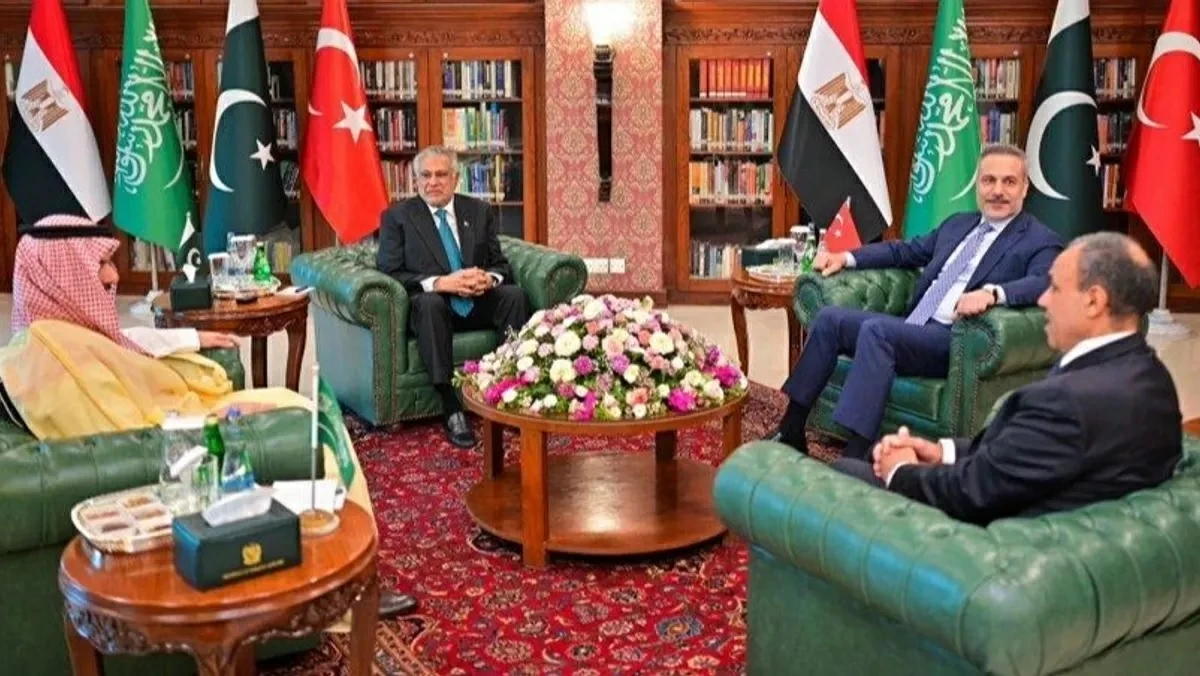
Foreign ministers from Egypt, Saudi Arabia, Turkey, and Pakistan met today (Sunday) in the Pakistani capital, Islamabad, where they agreed on the necessity of enhancing joint coordination and continuing consultations to support efforts aimed at de-escalating tensions and establishing security and stability in the region. This meeting comes at a sensitive time, as fears grow regarding the expansion of the Iranian war and its negative impacts on regional and international security.
During the meeting, the ministers exchanged assessments regarding the severe economic repercussions of the Iranian war, which include its effects on international navigation, supply chains, and food security, in addition to its implications for energy security amid rising oil prices. The Egyptian Foreign Ministry confirmed in a statement that these issues were central to the discussions, which were addressed in depth by the ministers.
Details of the Meeting
Ambassador Tameem Khalaf, spokesperson for the Egyptian Foreign Ministry, confirmed that the meeting focused on ways to enhance joint coordination to address the rapidly evolving developments and the dangerous military escalation in the region. He emphasized the importance of prioritizing diplomacy and dialogue as the primary means to contain the crisis and its negative repercussions on the security and stability of the region. The efforts made within the framework of the quartet to de-escalate tensions and encourage the initiation of a negotiation track between the United States and Iran were also discussed.
Minister Badr Abdel-Aty stressed during the meeting the importance of regional and international efforts to contain the situation, considering that diplomatic solutions are the only way to address the current crisis. He expressed hope that joint efforts would lead to a reduction in tension and the initiation of a gradual path towards de-escalation, which could ultimately lead to the end of the war.
Background & Context
These meetings occur at a time when the Middle East is witnessing escalating tensions, particularly with the rising conflict between Iran and the United States, which has significantly impacted regional security. Earlier, Pakistani Foreign Minister Mohammad Ishaq Dar called on his Iranian counterpart Abbas Araghchi to de-escalate, emphasizing that dialogue and diplomacy are the only means to achieve lasting peace.
Concerns are growing that the Iranian war could exacerbate economic and social crises in the region, necessitating urgent action from the concerned countries to ensure stability. Recent events have shown that military escalation could lead to serious repercussions on food and energy security, requiring a swift and effective response.
Impact & Consequences
The potential consequences of this meeting are numerous, as it may contribute to enhancing regional and international coordination to address security and economic challenges. Additionally, the success of efforts to de-escalate tensions could lead to improved economic conditions in the region and enhance opportunities for dialogue among the concerned parties.
This meeting may also stimulate broader diplomatic efforts, involving other countries in the region, which could contribute to achieving long-term stability. Furthermore, strengthening collective security in the region is an urgent necessity to address unprecedented challenges targeting the sovereignty of nations.
Regional Significance
These developments are of great importance to the Arab region, as stability in the Middle East directly affects the security and economy of Arab countries. The success of these efforts could contribute to enhancing regional security and reducing the risks threatening Arab nations.
In conclusion, this meeting represents an important step towards achieving peace and stability in the region, reflecting the commitment of the concerned countries to work together to face common challenges. Dialogue and diplomacy are the main avenues to achieve the desired goals, opening new horizons for regional and international cooperation.