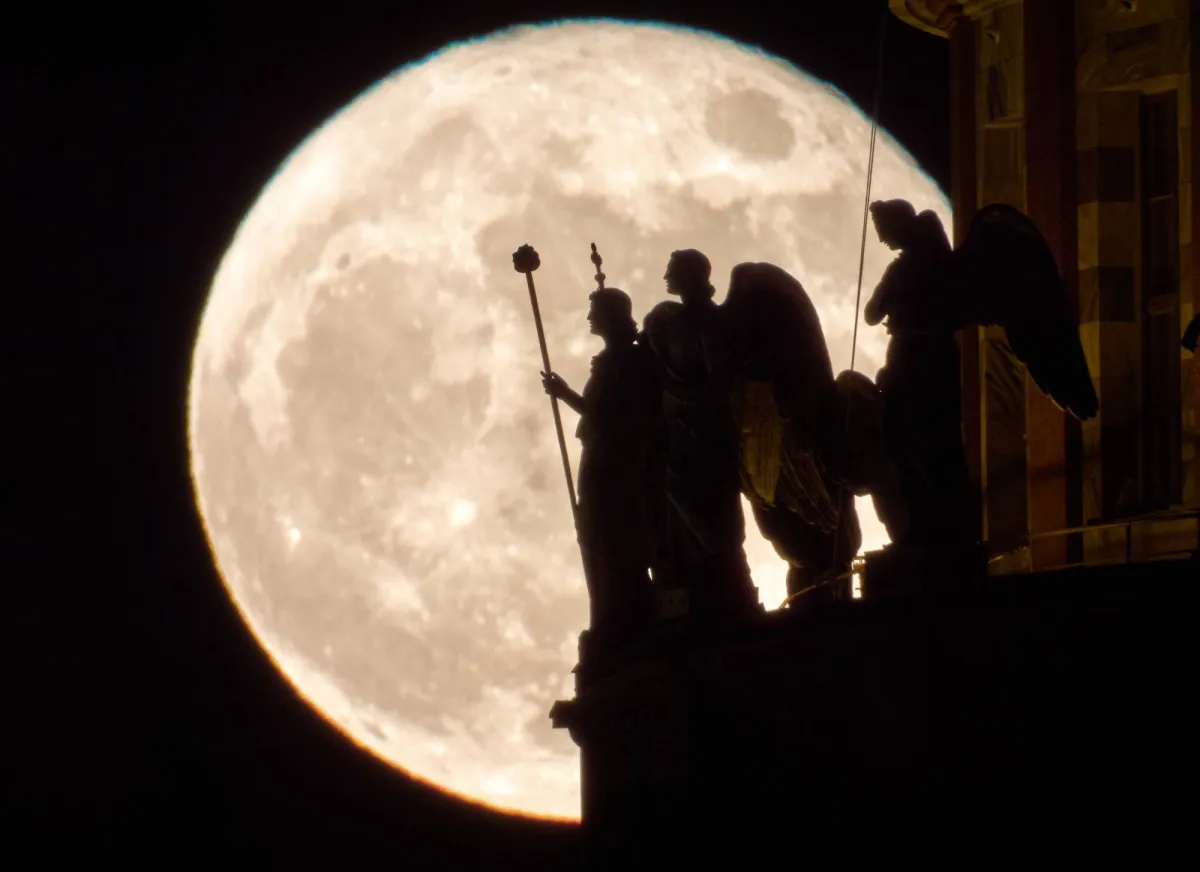
Discussions about the impact of the full moon on human behavior continue, with some believing it causes mood swings and strange behaviors. However, scientific research indicates no conclusive evidence supports this idea.
The full moon has long been associated with superstitions and unusual behaviors. This belief dates back to the first century AD when the Greek philosopher Aristotle and the Roman historian Pliny the Elder suggested that the full moon causes madness. In fact, the English word "lunatic" is derived from the Latin term "lunaticus," which means "of the moon" or "moonstruck."
Details of the Event
A report published by Verywell Mind reviewed what science says about the moon's influence and why this idea remains entrenched in many people's minds. Any "influence" of the moon may be linked to our ancestors, but its significant role in various spiritual practices, both ancient and modern, along with its ties to folklore and mythology, means that despite what science says, some still choose to believe in the moon's power.
In an ancient hypothesis, Aristotle and Pliny the Elder believed that the brain, being moist, could be affected by the moon just as the waters of the earth are influenced by it. Some contemporary thinkers have addressed this idea, such as psychologist Arnold Lieber, who explored it in his books "The Lunar Effect: Biological Tides and Human Emotions" (1978) and "How the Moon Affects You." Lieber suggested that the human body, composed of about 70% water, experiences tidal-like changes according to the moon's phases, similar to what occurs in the Earth's oceans.
Background & Context
While this theory may seem logical at first glance, experts have been quick to dismiss it. A study revealed that the gravitational pull of the Earth is 5,012 times stronger than that of the moon, and the moon's influence is less than the weight of a flea. While the moon regulates tides in large bodies of water, its effect on a glass of water, a bathtub, or the human body is considered negligible.
Astronomers, physicists, and psychologists have concluded that human behavior is not linked to the moon's phases. In 1985, researchers conducted an analysis of 37 studies comparing lunar cycles with rates of crisis center calls, suicides, crimes, and psychological issues, showing no correlation between the full moon and an increase in these cases.
Impact & Consequences
Recent studies have also confirmed no connection between the full moon and hospital admissions, psychological conditions, or aggressive behavior. In fact, a study conducted in Finland found that murder rates were lower during the full moon. When a belief persists for thousands of years, people may assume it has some basis.
An article suggested that the effect of "moon madness" may have originated because the bright moonlight affected our ancestors' sleep, potentially leading to sleep deprivation and mood changes. Today, some evidence indicates that sleep may indeed be affected by lunar cycles, which could explain some behavioral changes.
Regional Significance
However, many experts believe that the strong belief in the moon's influence is an example of "illusory correlation" or "confirmation bias," where people focus on events that support their beliefs while ignoring those that contradict them. We are more likely to notice strange occurrences when the moon is full, and these observations tend to stick in our memories.
Psychotherapist Amy Morin states, "The expectation that things become stranger during the full moon can turn into a self-fulfilling belief. People may start to behave differently because they think they should."
Whether the moon has a hidden influence on human behavior or not, there is a conscious aspect to how humans interact with its cycles. The moon holds significant importance in the cultures of indigenous peoples worldwide, often regarded as the "Moon Grandmother" who regulates tides and watches over the Earth's waters.
In astrology, lunar cycles are believed to significantly affect behaviors and emotions. The moon is often associated with the subconscious, and the "moon sign" is thought to reveal emotions and intuition. Conscious alignment with the moon's phases is viewed as a powerful self-care tool, with each phase linked to specific activities that vary by culture.
Although science has debunked many myths associated with the moon, some still cling to these beliefs.