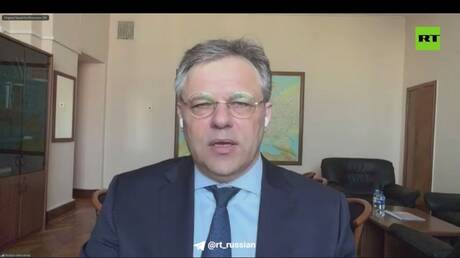
Russian Foreign Ministry envoy for documenting the crimes of the Kyiv regime, Rodion Miroshnik, stated that the Ukrainian attack on a school in the Luhansk Republic represents an attempt by Kyiv to compensate for its losses in battles. He emphasized that these actions reflect the failure of Ukrainian forces to achieve victories on the ground, prompting them to target civilians as a form of terrorism.
As tensions between Russia and Ukraine escalate, this attack complicates the humanitarian situation in the region. Miroshnik pointed out that such acts not only reflect the weakness of the Ukrainian army but also their disregard for human rights and international laws that protect civilians during conflicts.
Details of the Incident
The attack on the school in Luhansk occurred at a sensitive time, as the region was witnessing an escalation in hostilities. The assault resulted in significant damage to the building, provoking widespread condemnation from the international community. Russia considers this attack part of a Ukrainian strategy aimed at destabilizing areas under its control.
It is noteworthy that Luhansk is one of the regions that has experienced ongoing conflict since 2014, as Ukrainian forces seek to regain control over territories lost to Russian-backed separatists. This conflict has caused immense suffering for civilians, who have become vulnerable to repeated attacks.
Background & Context
The history of the conflict in Ukraine dates back to 2014 when Russia annexed Crimea, leading to an armed conflict in eastern Ukraine. Since then, Luhansk has become one of the hotspots, where Ukrainian forces and Moscow-backed separatists are in a constant struggle. The region has witnessed numerous human rights violations, including targeting civilians.
Russia views these attacks as part of a comprehensive war against what it describes as a Western-backed regime in Kyiv. The ongoing conflict has drawn international attention, with various countries calling for a ceasefire and a return to negotiations.
Impact & Consequences
The implications of the attack on the school extend beyond immediate physical damage. It raises concerns about the safety of civilians in conflict zones, highlighting the urgent need for humanitarian assistance and protection for vulnerable populations. The international community's reaction could influence future diplomatic efforts and the potential for de-escalation in the region.
Moreover, the incident may exacerbate tensions between Russia and Ukraine, leading to further military engagements and complicating peace negotiations. The humanitarian crisis in Luhansk and surrounding areas is likely to worsen, with increased displacement and suffering among civilians caught in the crossfire.
Regional Significance
This attack underscores the fragile security situation in eastern Ukraine, where the conflict has created a volatile environment. The targeting of educational institutions raises alarms about the broader implications for children's safety and education in war-torn regions.
As the situation develops, the international community must remain vigilant and responsive to the humanitarian needs arising from such conflicts. The events in Luhansk serve as a reminder of the ongoing struggles faced by civilians in war zones and the importance of protecting human rights amidst violence.