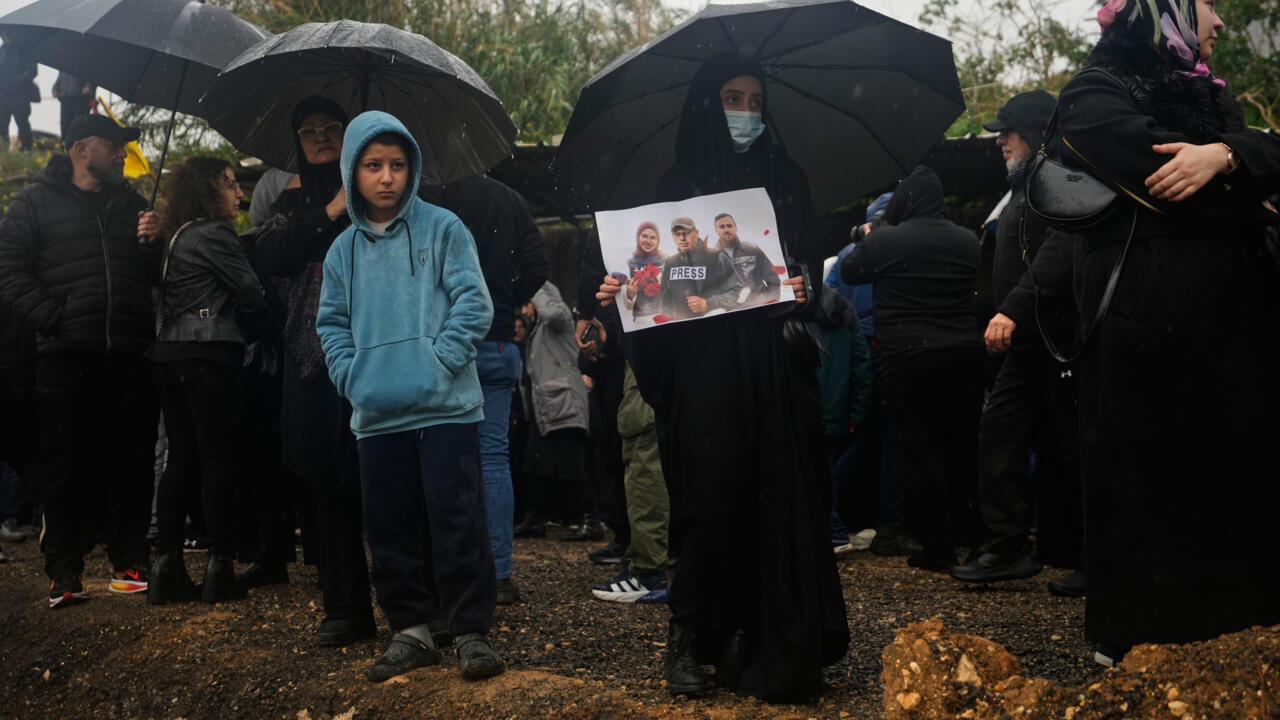
Hundreds of people gathered in the southern suburbs of Beirut on Sunday to mourn the bodies of three journalists who were killed in an Israeli airstrike targeting them in southern Lebanon on Saturday. This attack sparked angry reactions from Lebanese authorities and the international community, with Lebanese President Joseph Aoun describing it as a 'blatant crime' that violates all international norms and treaties.
The victims were Ali Shaib, a correspondent for the Hezbollah-affiliated Al-Manar channel, Fatima Fatouni, a reporter for Al-Mayadeen channel, and her brother, photographer Mohammad Fatouni. Their vehicle was struck by an Israeli airstrike while they were in the Jezine area, resulting in their immediate deaths.
Details of the Incident
The Israeli army acknowledged responsibility for the death of Ali Shaib, claiming he was operating within Hezbollah's Radwan unit, disguised as a journalist. However, the army did not provide any evidence to support this claim. The Israeli military also did not comment on the deaths of Fatima and Mohammad Fatouni, which intensified the criticism directed at them.
Hundreds attended the funeral of the three journalists, who were wrapped in the flags of Al-Manar and Al-Mayadeen channels, with their coffins surrounded by flowers. A relative of Fatima, who preferred not to disclose his full name, stated: 'Fatima was a hero, and Ali was a hero. They were filming in the south even under bombardment.' Meanwhile, Ali Hashem, a close friend of Shaib, expressed his deep sorrow but affirmed that 'we will not be broken.'
Background & Context
This airstrike comes at a time of escalating military tensions in the region, as Hezbollah, backed by Iran, launched rockets at Israel on March 2 in response to the assassination of Iranian Supreme Leader Ali Khamenei. Israel retaliated with extensive airstrikes on Lebanon, leading to heightened tensions in the area.
Since the beginning of the war between Hamas and Israel in 2023, the Committee to Protect Journalists has documented the deaths of 11 journalists in Lebanon due to Israeli fire. Reports also indicate that 210 Palestinian journalists and media workers have lost their lives since the start of this year.
Impact & Consequences
This attack raises questions about the safety of journalists in conflict zones, with French Foreign Minister Jean-Noël Barrot condemning the targeting of journalists, stating that 'journalists should never be targeted in war zones.' He emphasized that deliberately targeting them constitutes a blatant violation of international law.
Concerns are growing that such incidents could lead to a deterioration of press freedom in the region, as journalists are often seen as targets in armed conflicts, endangering their lives and affecting their ability to cover events objectively.
Regional Significance
This incident serves as a stark reminder of the challenges faced by journalists in the Arab world, especially in conflict areas. Targeting journalists threatens freedom of expression and undermines efforts to highlight human rights violations.
Amid rising tensions in the region, the question remains on how to protect journalists and ensure their safety while performing their professional duties. These incidents underscore the urgent need to strengthen international laws that protect journalists and guarantee their rights to work safely.
In conclusion, the killing of the three journalists in Lebanon highlights the dangers faced by media personnel in conflict zones and reflects the need for urgent international action to protect press freedom and ensure the safety of those working in this field.