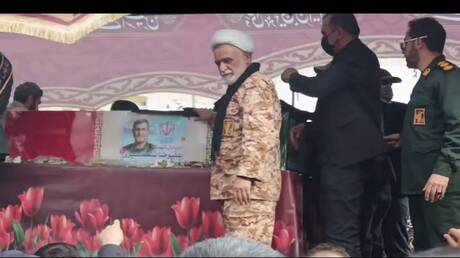
Hundreds of Iranian citizens flocked to Tehran to participate in the funeral of Admiral Ali Reza Tangsiri, the commander of the Revolutionary Guard's naval forces, who died from injuries sustained in an Israeli strike. The ceremonies were held at one of the major mosques in the capital, where several military and political officials delivered eulogies in his honor.
Admiral Tangsiri was a prominent figure in the Iranian Revolutionary Guard, having led the naval forces since 2019. He played a significant role in enhancing Iran's naval capabilities, including the development of the military fleet and strengthening naval operations in the Persian Gulf. His death comes at a sensitive time marked by increasing tensions between Iran and Israel, raising fears of greater security escalation.
Details of the Event
The funeral was attended by a large number of military and civilian personnel, with the admiral's body displayed in a grand procession. Prayers were held for him in the presence of several senior military leaders, who emphasized the importance of his role in enhancing Iranian national security. Slogans calling for revenge against the aggressors were chanted, referring to the Israeli strike that led to his death.
This incident follows a series of attacks and military operations targeting Iranian interests in the region, reflecting a state of security instability. Some analysts have noted that this strike may be part of a broader Israeli strategy aimed at undermining Iranian influence in the Middle East.
Background & Context
Historically, relations between Iran and Israel have been tense, with both countries exchanging accusations of hostile actions against each other. Since the Islamic Revolution in 1979, Iran has supported armed groups in the region, exacerbating the conflict with Israel. Admiral Tangsiri was part of this dynamic, leading naval operations aimed at protecting Iranian interests in territorial waters.
Regional and international pressures on Iran have increased in recent years, especially following the United States' withdrawal from the nuclear agreement in 2018. This withdrawal led to the imposition of severe economic sanctions on Tehran, affecting its military and economic capabilities.
Impact & Consequences
The death of Admiral Tangsiri may lead to an escalation of tensions between Iran and Israel, as Tehran may seek to respond to the strike through military operations or attacks on Israeli targets. This incident could also impact stability in the region, potentially increasing tensions in the Persian Gulf, which is a critical strategic point for global trade.
Analysts expect Iran to respond strongly to this strike, which could open the door to a new round of conflict in the region. Additionally, these events may affect relations between Iran and Western countries, which are closely monitoring the situation.
Regional Significance
The death of Admiral Tangsiri is a significant event not only for Iran but for the entire Arab region. The tensions between Iran and Israel could affect regional security and place Arab countries in a difficult position between supporting Iran or maintaining their relations with the West. Any military escalation could lead to economic and security repercussions for neighboring countries.
In light of these circumstances, Arab nations must exercise caution in their dealings with these situations, as any escalation could impact the stability of the entire region. It is also crucial for Arab countries to remain united in facing the security challenges that may arise from these events.