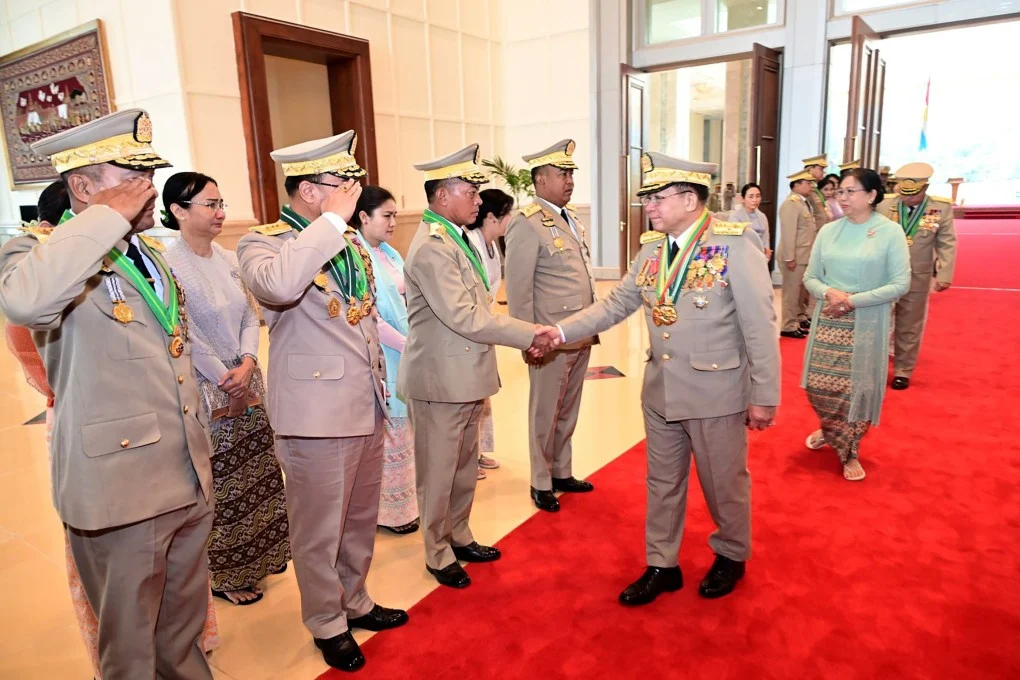
Myanmar announced on Monday the nomination of General Min Aung Hlaing, the military coup leader, as vice president, paving the way for him to take over the presidency of the country. This decision comes five years after his strict rule began following the ousting of the elected government led by Aung San Suu Kyi, who was arrested and whose party was dismantled, leading to a civil war in the country.
The new step reflects the continued military control over governance in Myanmar, as Hlaing was replaced as military commander, allowing him to appear civilian while retaining actual power. This change comes at a time when the country suffers from increasing humanitarian and economic crises due to ongoing conflict.
Details of the Event
In an unsurprising move, the parliament in Myanmar nominated General Min Aung Hlaing to be vice president, reflecting the military council's desire to maintain control over the country under a civilian guise. This nomination comes after Hlaing led a military coup in February 2021, where the elected government was ousted and many political leaders, including Nobel laureate Aung San Suu Kyi, were arrested.
Over the past years, Myanmar has faced widespread international criticism for human rights violations and mass arrests. However, it seems that the military council is proceeding with its plan to secure its power by changing political forms, allowing it to continue ruling without facing direct pressures.
Background & Context
Historically, Myanmar has witnessed long periods of military rule, with the army seizing power on several occasions. In 2015, the country experienced a relatively democratic transition with the victory of the National League for Democracy led by Aung San Suu Kyi in the elections. However, this transition did not last long, as the armed forces regained control in 2021.
This coup led to a surge in popular protests, which were met with severe violence from security forces, resulting in thousands of deaths and the arrest of many activists. The humanitarian situation in the country is continuously deteriorating, with the population suffering from severe shortages of food and medicine, in addition to internal displacement due to ongoing conflicts.
Impact & Consequences
The recent steps taken by the military council in Myanmar could exacerbate the humanitarian and political situations in the country. While Hlaing seeks to present a civilian image of his rule, the reality indicates a continuation of repression and violations. This situation may provoke strong international reactions, as countries are likely to impose new sanctions on the military regime.
Moreover, the continuation of military rule could worsen internal conflicts, potentially threatening the stability of the entire region. Neighboring countries, such as Thailand and Bangladesh, may face negative repercussions due to an influx of refugees or increased border tensions.
Regional Significance
For the Arab world, events in Myanmar remind us of the importance of democracy and human rights. Many Arab countries have experienced similar experiences of military rule and repression. What is happening in Myanmar can serve as a lesson for countries seeking stability through repression rather than dialogue and political participation.
In conclusion, the question of Myanmar's future remains open, as challenges mount for a people striving for freedom and justice. The continuation of the current situation could lead to further division and chaos, necessitating urgent international intervention to protect human rights and achieve peace in the country.