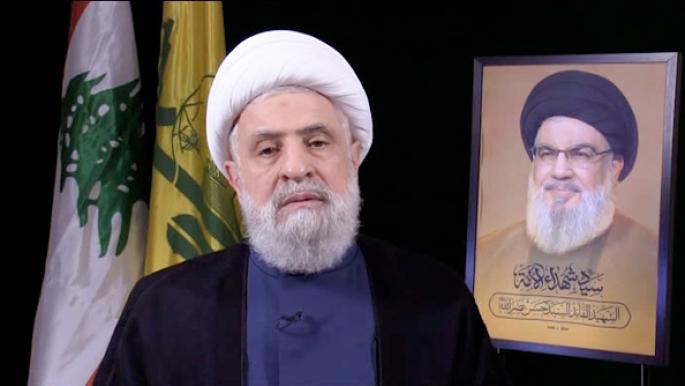
Hezbollah's Secretary-General, Na'im Qassem, asserted in a speech today that there is no yellow line or buffer zone in southern Lebanon, emphasizing that this will not happen in the future. These remarks come at a sensitive time in the region, where tensions between various parties are escalating.
Qassem, one of the prominent leaders in Hezbollah, indicated that direct negotiations with the concerned parties are viewed as a free concession, reflecting the party's firm stance on regional and local issues. His statements arise amid increasing tensions in the area, raising questions about the future of relations between Lebanon and Israel.
Details of the Statement
In his remarks, Qassem clarified that Hezbollah will not accept the existence of buffer zones or dividing lines in the south, which reflects the party's commitment to Lebanese sovereignty. He added that any attempts at direct negotiations will not yield positive results but will instead be seen as unjustified concessions.
These statements come at a time when Lebanon is facing significant economic and political challenges, as the party seeks to maintain its power and influence under these circumstances. Additionally, the security situation in the region remains fragile, complicating matters further.
Background & Context
Historically, the Lebanese-Israeli border has witnessed ongoing tensions, with numerous attempts to establish buffer zones or dividing lines. However, Hezbollah, founded in the 1980s, considers any concession of Lebanese territory as an affront to national sovereignty.
In recent years, tensions between Hezbollah and Israel have escalated, particularly following repeated military escalations. This backdrop makes Qassem's statements particularly significant, as they reflect the party's steadfast position in the face of external pressures.
Impact & Consequences
Qassem's statements could lead to an escalation of tensions in the region, as they may be interpreted as a challenge to international efforts aimed at achieving peace and stability. Furthermore, the party's firm stance may strengthen its position within Lebanon, but it could simultaneously increase external pressures on it.
These statements are likely to affect relations between Lebanon and neighboring countries, especially given the rising regional tensions. Any escalation could also impact Lebanon's fragile economic situation, which is suffering from multiple crises.
Regional Significance
Qassem's statements are part of the larger picture of tensions in the Middle East, where regional powers play a crucial role in shaping the course of events. Hezbollah's unwavering position may influence the stability of the region and reflects the challenges faced by Arab countries in dealing with border and sovereignty issues.
In conclusion, Qassem's remarks serve as an indicator of Hezbollah's future directions and highlight the challenges facing Lebanon in the context of a tense region. It is essential to monitor upcoming developments to understand how these positions will affect the security and political situation in the area.