Amid the challenges weighing heavily on Lebanon, the exhibition 'Nevertheless' emerges as a ray of light piercing through the darkness, delicately touching on the wounds. It does not come with fanfare or self-celebration; instead, it flows quietly, as if it were a silent act of survival. The exhibition gathers a select group of artists whose works resonate with the anxiety and fragility of the current phase, forming their paintings as a mirror to a shifting reality and a window to another place of life.
Without announcement or noise, it opens its doors to works that withstand interruptions, tensions, and a time burdened with shadows. Here, the painting is not merely a visual expression; it transforms into an act of survival and a hidden salute to all those who still, despite everything, seek a glimmer of hope.
Event Details
The exhibition includes works by Hebat Ballaa Bouab, George Basil, Wissam Baydoun, Zouhair Dabbagh, Mansour Al-Habri, Layla Dagher, and others. Most of them pulse with Lebanon in all its contradictions, narrating its story through sweet and bitter days, its breaks and resilience, its chaos and nostalgia, and its memory burdened with what was and what still is. The homeland is not presented as a single image but as a multifaceted state, torn between shadows and light, which art reinterprets in a deeper and more truthful language.
The exhibition opened in early April and did not close its doors during the war, taking place at the 'Art on 56' gallery in the Gemmayzeh area. The event organizer and owner of the space, Noha Maharam, told 'Asharq Al-Awsat': 'I am a dreamer and optimistic by nature, and I pride myself on always holding onto hope to continue and endure. The gallery had a busy schedule of exhibitions planned for the last season of the year and before the summer began, but the war came to obliterate our program.'
She continues: 'We canceled exhibitions for the next two months, but we refused to close the gallery's doors. We decided to open an exhibition directly related to the situation we are living in. And we did so quietly, receiving enthusiasm from a significant number of visual artists. Thus, we embarked on a journey filled with hope, naming the exhibition 'Nevertheless' to indicate the continuity we aspire to.'
Background & Context
Among the striking paintings in the exhibition is one by Ghada Jamal that tells the story of wounded and bandaged Lebanon, using mixed media on wood. Noha Maharam explains: 'This painting was created by the artist years ago, and she intended it as a bridge connecting wounded Lebanon with the one on the path to healing. We chose to display it in commemoration of the outbreak of the war in Lebanon on April 13, 1975.'
The painting embodies her vision of a recovering Lebanon, where she employs various materials to weave through accumulated layers, as if storing the harsh stages the country has gone through. Medical gauze bandages are integrated within the work, directly referencing its open wounds and attempts to heal them. The artist does not merely document the pain but engages in a symbolic act of restoration, wrapping storms and destruction with layers of care, and from the heart of suffering, opens a horizon for a new path toward healing.
Impact & Consequences
Meanwhile, Layla Dagher's painting, exhibited for the first time, takes us through phases of Lebanon. At first glance, it appears like a reassembled natural scene with a wounded memory. Elements accumulate within it using collage technique, intertwining colorful scraps as if they were fragments of a land reassembled. Layers of blue extend at the top, suggesting a heavy sky or a clouded horizon, while warm earthy colors of orange and red gradient in the middle. We sense hope through the density of greenery in irregular shapes, forming signals of life despite everything, balancing between cold and warm colors.
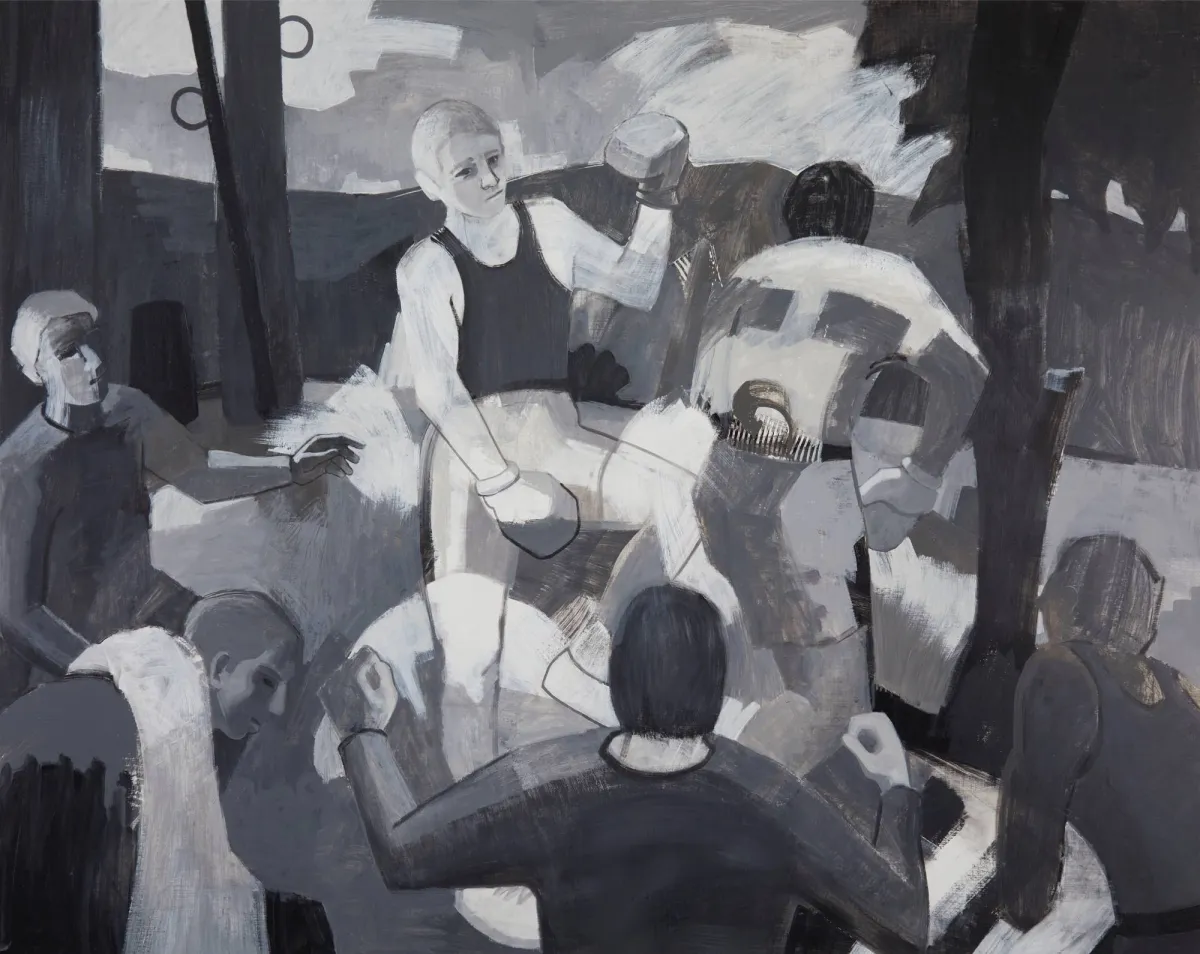
Here, harshness coexists with touches of reassurance, and the horizon remains open to the possibility of future restoration. Edgar Mazji places conflicts at the forefront in black and white acrylic, focusing on their features away from embellishment and ostentation. We see a group of young people gathered around a ring where two individuals wearing boxing gloves are fighting.
Regional Significance
With a painting by Hebat Ballaa Bouab, using both mixed media and collage techniques, we transition to a Lebanese scene pulsating with nostalgia, where family gatherings coexist with the charm of breathtaking nature, as if the place retains a memory of warmth threatened with disappearance. Still faces and bodies move under the weight of days, and vibrant colors provide the characters of the painting with reassurance amid a harsh reality.
In the 'Nevertheless' exhibition, Lebanon is present in all its contradictions: suffering, wounded, and resilient all at once. The country is displayed not as a complete image but as an emotional state open to longing, disappointment, and hope. The visitor does not merely observe but embarks on an emotional journey toward a more truthful Lebanon.
Noha Maharam notes that the audience of the exhibition came from various age groups, suggesting that the need for art here transcends taste to become a psychological necessity. She says: 'They came to the exhibition driven by hope and were happy to have this space in the heart of the capital. Many found it a refuge that distances them from the atmosphere of war, a temporary withdrawal from the weight of reality.'