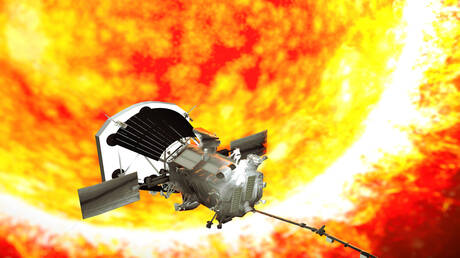
A recent study has revealed that particles emitted from the sun do not behave uniformly, reshaping scientific understanding of the 'magnetic engine' that drives solar winds. Solar winds are natural phenomena that impact Earth's space environment and play a vital role in shaping climatic conditions in space. New research has shown that these particles, primarily composed of electrons and protons, interact in different ways with the sun's magnetic field, opening new avenues for understanding solar dynamics.
The study demonstrated that solar particles can be divided into two main groups, each exhibiting distinct behaviors upon their release from the sun. These findings were made possible by data collected from the Parker Solar Probe, launched in 2018 to study the sun up close. This probe has provided scientists with a unique opportunity to observe the behavior of solar particles in a near-solar environment.
Details of the Findings
The new results also include information on how these particles affect Earth's space environment. While previous studies suggested a uniform behavior of particles, the current findings indicate a significant variation in their behavior, necessitating a reevaluation of existing models that explain solar wind movement.
Historically, research on the sun and solar winds has focused on understanding how the sun affects Earth. Solar winds, which consist of a continuous flow of charged particles, play a crucial role in shaping Earth's magnetic field, impacting both wired and wireless communications as well as satellites.
Background & Context
Since the launch of the Parker Solar Probe, significant advancements have been made in our understanding of the sun. This probe is the first of its kind to approach the sun closely, gathering precise data on the behavior of solar particles. The results obtained so far reflect the importance of this scientific project in enhancing knowledge about solar phenomena.
The implications of the new findings suggest that understanding solar particle behavior could help improve predictions related to space weather. This has significant implications for modern technology, as solar winds can affect satellites and communication systems.
Impact & Consequences
Moreover, these discoveries may influence how protection systems for satellites and electronic devices in space are designed. With the increasing reliance on space technology, it becomes essential to better understand the interactions between solar particles and magnetic fields.
In the Arab region, these discoveries may have indirect effects on various fields, including communications and technology. As reliance on satellites in areas such as communications and broadcasting increases, understanding solar wind behavior can help enhance protection and security strategies.
Regional Significance
These studies also emphasize the importance of scientific collaboration between Arab countries and advanced nations in the field of space, opening new horizons for innovation and development in this vital area.
The results of the new study reflect significant progress in our understanding of the sun and solar winds. As research continues, we can hope for further discoveries that may change the way we understand the universe around us.