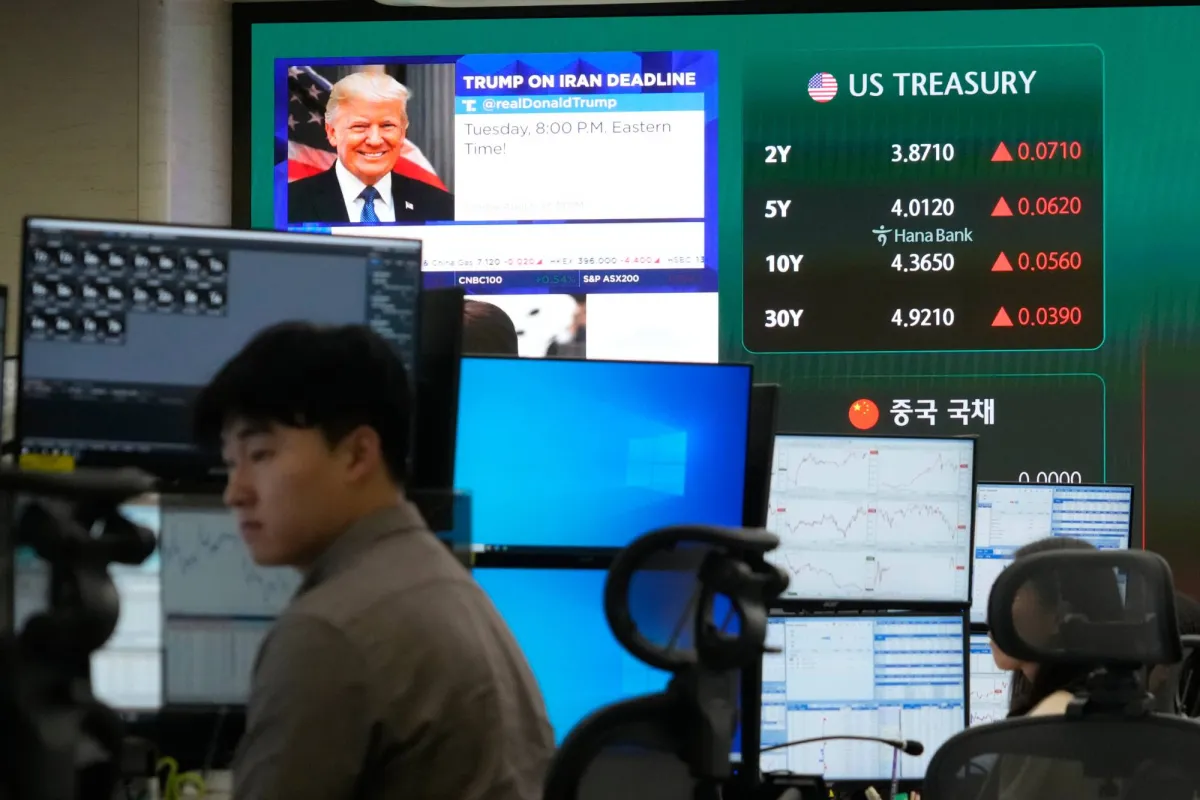
Asian markets opened on Monday with a sense of heightened anticipation and tension, as oil prices recorded a significant increase against a backdrop of declining bonds and mixed stock performances. This disruption is driven by U.S. President Donald Trump's threats of a broad attack targeting Iranian infrastructure, warning Tehran of 'hell' unless it complies with the deadline he set for reopening the strategic Strait of Hormuz.
Trump's repeated warnings about destroying civilian facilities, including power stations and bridges by Tuesday, have raised deep concerns among investors about the potential for a wave of retaliatory attacks in the region, which could target vital assets in Gulf countries. Amid weak liquidity due to public holidays in several countries in the region, futures contracts for the S&P 500 index fell by 0.2%, while the MSCI Asia-Pacific index rose by 0.5%, and the Japanese Nikkei index recorded an increase of 1.2%.
Details of the Event
In the energy market, Brent crude futures jumped by 1.4% to reach $110.58 per barrel. Additionally, U.S. West Texas Intermediate crude futures rose by $0.71, or 0.6%, to $112.25 per barrel. On Thursday, the last trading day before the Good Friday holiday, West Texas Intermediate crude prices surged by over 11%, while Brent crude prices jumped by about 8% in volatile trading, marking the largest absolute price increase since 2020, following Trump's promise to continue attacks on Iran.
The Strait of Hormuz remains largely closed due to Iranian attacks on maritime navigation since the war began on February 28. Given the supply disruptions in the Middle East, refineries are seeking alternative sources of crude oil, particularly for actual shipments in the U.S. and British North Sea.
Background & Context
In a note to clients on Monday, the 'Shork' group stated, 'Global buyers are fiercely competing for barrels from the U.S. Gulf Coast, and Brent prices are rising faster.' On Sunday, Trump escalated pressure on Tehran, threatening in a vulgar social media post to target Iranian power stations and bridges on Tuesday if the strategic Strait of Hormuz is not reopened.
However, shipping data showed that some vessels, including an Omani oil tanker, a French container ship, and a Japanese gas carrier, have crossed the Strait of Hormuz since Thursday, reflecting Iran's policy of allowing the passage of ships from countries it considers allies. The threats indicate a continuation of the conflict, as Iran officially informed intermediaries that it is not prepared to meet with U.S. officials in the Pakistani capital Islamabad in the coming days.
Impact & Consequences
On Sunday, the 'OPEC Plus' alliance agreed to a slight increase of 206,000 barrels per day for May. Russian supplies have recently been disrupted due to Ukrainian drone attacks on the Russian export terminal in the Baltic Sea. Media reports on Sunday indicated that the Ust-Luga terminal resumed shipping operations after days of inactivity.
Gold prices fell on Monday, influenced by a strong dollar, as rising oil prices amid the prolonged Iranian war and stronger-than-expected U.S. job data diminished hopes for interest rate cuts by the Federal Reserve. Spot gold prices dropped by 0.9% to $4631.69 per ounce, while U.S. gold futures for April delivery fell by 0.5% to $4657.50.
Regional Significance
The ministerial monitoring committee of the 'OPEC Plus' alliance has sounded the alarm regarding the implications of the war, expressing concern over attacks targeting energy infrastructure. They confirmed that any actions undermining the security of energy supplies increase market volatility and weaken collective efforts under the 'Declaration of Cooperation' that support market stability.
In conclusion, it is evident that global markets are closely monitoring developments in the region, as any new escalation could negatively impact the global economy and directly affect energy prices and commodity markets.